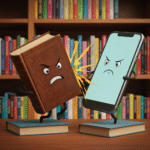
And winning in ways that might surprise you
Picture this: You’re sitting in a coffee shop, watching a fascinating battle unfold. On one side, there’s Sarah, 67, completely absorbed in a dog-eared paperback, coffee ring stains marking her progress through the pages. On the other side sits Jake, 22, frantically swiping through three different reading apps, jumping between an audiobook, highlighted PDF notes, and social reading features.
Both are reading. Both are learning. But they’re living in completely different universes.
Welcome to the most unexpected plot twist in modern reading culture: just when everyone predicted the death of physical books, paperbacks are experiencing a renaissance that’s leaving tech executives scratching their heads.
The Paper Revolution Nobody Saw Coming
Here’s a statistic that would make Steve Jobs roll in his grave: paperback sales increased by 12% in 2023, while e-book growth has plateaued. Gen Z, the generation supposedly glued to screens, is driving much of this growth. They’re buying paperbacks not despite having smartphones, but because they have smartphones.
“I spend eight hours a day staring at screens for work,” explains Maya Chen, a 26-year-old software developer clutching a worn copy of Dune. “By evening, the last thing I want is another glowing rectangle. A paperback is like a vacation for my eyeballs.”
But this isn’t just about digital fatigue. Something deeper is happening.
The Neuroscience of Turning Pages
Dr. Elena Rodriguez, a cognitive psychologist at Stanford, has spent five years studying how our brains process information differently when reading physical versus digital text. Her findings are striking: “When people read paperbacks, we see increased activity in the hippocampus—the brain’s memory center. There’s something about the physical act of turning pages, the spatial memory of where information appeared on a page, that creates stronger neural pathways.”
Translation? You literally remember more when you read a physical book.
This explains why students who take notes by hand consistently outperform those who type, and why readers of physical books score higher on comprehension tests than those reading the same content digitally. Your brain treats a paperback like a 3D map, creating a rich mental landscape of the story or information.
The App Invasion: Reading Gets Supercharged
But don’t count digital out just yet. While paperbacks are having their moment, reading apps are evolving at breakneck speed, offering experiences that would have seemed like science fiction just five years ago.
Speechify has revolutionized audiobooks by letting users adjust reading speed up to 5x normal pace. CEO Cliff Weitzman, who’s dyslexic, created the app after struggling through law school. “I was reading at 150 words per minute while my classmates were at 250. Now I read at 1,000 words per minute through audio,” he says. The app now has over 20 million users who’ve discovered they can consume entire books during their commute.
Readwise has turned highlighting into an art form. The app resurfaces your favorite book quotes through spaced repetition, essentially turning your reading into long-term memory formation. Users report remembering 60% more from books they’ve highlighted through the app compared to traditional reading.
StoryGraph has become the Instagram of reading, but with AI that actually understands your taste. Unlike basic recommendation engines, it analyzes mood, pace, and character development to suggest books with scary accuracy. One user described it as “having a librarian who’s read every book and knows your soul.”
The Attention War
Here’s where the battle gets personal. Dr. Cal Newport, author of Digital Minimalism, argues that the fundamental difference isn’t about paper versus pixels—it’s about attention architecture.
“Apps are designed to fragment your attention,” Newport explains. “Even the best reading app still exists within an ecosystem of notifications, social features, and constant connectivity. A paperback creates what I call ‘attentional sanctuary’—a protected space where deep focus can flourish.”
The numbers back this up. Studies show that people reading physical books focus for an average of 42 minutes before distraction, while digital readers average just 19 minutes. But here’s the twist: when digital readers use focus-specific apps like Cold Turkey or enable airplane mode, their focus duration jumps to 38 minutes.
The tool isn’t the enemy—the environment is.
Generation Hybrid: The Best of Both Worlds
Meet the new reading revolutionaries: they’re not choosing sides. Alex Park, a 19-year-old college student, has developed what he calls a “hybrid reading system” that would make productivity gurus weep with joy.
“I use Blinkist for book discovery—their 15-minute summaries help me decide what deserves my full attention. If a book passes the test, I buy the paperback for deep reading and use Audible for review sessions while walking. Then Goodreads helps me remember what I’ve read and connect with other readers.”
This approach is becoming the norm among power readers. They’re treating apps and paperbacks not as competitors, but as different tools for different reading jobs.
The Unexpected Psychology of Ownership
There’s something primal happening with paperback ownership that apps can’t replicate. Dr. Russell Belk, who studies consumer behavior, calls it “the extended self phenomenon.”
“When you own a physical book, it becomes part of your identity in ways digital books never can,” Belk explains. “You can lend it, see it on your shelf, smell it, annotate it. Each book becomes a physical artifact of who you were when you read it.”
This explains the Instagram-worthy bookshelves filling social media feeds. Young readers aren’t just collecting books; they’re curating physical representations of their intellectual journeys. Try doing that with your Kindle library.
The Future Is Already Here
But the most exciting developments are happening at the intersection of physical and digital. Booktrack adds soundtracks to e-books, creating cinematic reading experiences. OwlCrate has turned book subscription boxes into a $100 million industry, making physical book buying into an experience economy.
Meanwhile, apps like Epic! are revolutionizing how children read, gamifying the experience while maintaining the core joy of storytelling. Kids using Epic! Read 41% more than their peers—proving that when designed thoughtfully, digital tools can enhance rather than replace reading culture.
The Surprising Winner
So who’s winning the great reading war? Plot twist: we all are.
Reading rates are actually up across all demographics for the first time in decades. The average American now reads 14 books per year compared to 12 in 2010. The paper-versus-digital debate created so much attention around reading that it reminded people why they loved books in the first place.
Sarah, our coffee shop paperback reader, later tells me she also uses StoryGraph to track her reading and Libby to access library books instantly. Jake, the app enthusiast, has a growing collection of paperbacks for books that “changed his life.”
The future of reading isn’t about choosing between paper and pixels. It’s about understanding that different reading goals require different tools. Want to focus deeply? Grab a paperback. Need to multitask? Fire up an audiobook app. Want to discover new authors? Let AI algorithms guide you.
The Real Revolution
The real revolution isn’t technological—it’s cultural. We’re witnessing the emergence of a generation that refuses to be defined by artificial either-or choices. They’re creating reading lives that are richer, more varied, and more intentional than any generation before them.
In a world of infinite digital distractions, both paperbacks and thoughtful reading apps offer the same precious commodity: focused attention. The medium matters less than the mindset.
As Maya Chen puts it, closing her paperback copy of Dune while her phone buzzes with reading recommendations from her latest app: “The best reading tool is the one that disappears, leaving just you and the story. Sometimes that’s paper, sometimes that’s pixels. Usually, it’s both.”
The reading revolution isn’t about choosing sides. It’s about choosing to read at all. And by that measure, we’re living in the golden age of reading—no matter what you’re reading it on.
The Bookstore Renaissance Nobody Expected
Walk into any independent bookstore today, and you’ll witness something remarkable: they’re busier than they’ve been in decades. Powell’s Books in Portland reports a 23% increase in foot traffic since 2020, while new independent bookstores are opening at their fastest rate since the 1990s.
But here’s the kicker—many of these bookstore visitors discovered their next purchase through reading apps. BookTok on TikTok has single-handedly revived interest in fantasy novels, driving paperback sales of books like The Seven Husbands of Evelyn Hugo into multiple reprints. Digital discovery is fueling physical purchases in ways no one predicted.
“My customers come in with screenshots from Goodreads, asking for books their reading apps recommended,” says Jennifer Martinez, owner of Turning Pages bookstore in Austin. “The apps aren’t killing bookstores—they’re saving them by helping readers discover what they actually want to read.”
The Concentration Crisis Solution
Perhaps the most important battle being fought isn’t between formats, but for our collective ability to concentrate. Dr. Gloria Mark’s research at UC Irvine shows that the average person now checks their phone every 12 minutes. In this environment, both paperbacks and focus-designed apps serve as refuges for sustained attention.
Apps like Forest gamify focus by growing virtual trees during distraction-free reading sessions, while Freedom blocks distracting websites and notifications. Meanwhile, the simple act of opening a paperback creates what psychologists call “attentional reset”—a clean break from digital overwhelm.
“We’re not just choosing how to read,” explains Dr. Newport. “We’re choosing whether to maintain our capacity for deep thought at all.”
The Memory Palace Effect
Recent neuroscience research reveals another fascinating dimension to this debate. Dr. Maryanne Wolf’s studies at UCLA demonstrate that readers who combine physical and digital reading develop what she calls “enhanced cognitive flexibility”—a better ability to switch between different types of thinking.
“Digital readers excel at scanning, pattern recognition, and information synthesis,” Wolf explains. “Physical book readers show superior linear thinking and narrative memory. But readers who use both formats? They develop the best of both cognitive skill sets.”
This explains why many successful entrepreneurs, scientists, and artists maintain hybrid reading practices. They use apps for information gathering and paperbacks for deep contemplation, essentially training their brains for different types of cognitive work.
The Social Reading Revolution
One of the most surprising developments is how apps have made reading social again. Fable lets readers host virtual book clubs with real-time discussions. Literal combines social features with beautiful reading tracking. Even Kindle now shows what passages other readers highlighted, creating anonymous reading communities around every book.
“Reading used to be this solitary activity,” notes Dr. Radway, who studies reading communities at Duke University. “Apps have returned us to something closer to historical reading culture, when people gathered to discuss books and share passages. We’re more connected to other readers now than we’ve been in generations.”
The Affordability Revolution
Let’s address the elephant in the room: money. A paperback costs $10-15, while apps like Kindle Unlimited offer access to over 4 million books for $9.99 monthly. Scribd provides unlimited reading across books, magazines, and audiobooks for $11.99. For voracious readers, the math is compelling.
But the paperback market has responded with innovation. ThriftBooks has built a $100 million business selling used paperbacks online. Little Free Libraries have turned book sharing into a neighborhood phenomenon. Buy Nothing groups on Facebook facilitate massive book exchanges.
“The goal isn’t to own every book,” explains Marie Kondo of organizing fame, who’s become an unexpected voice in reading culture. “It’s to ensure that every book you encounter has the opportunity to spark joy, whether you own it, borrow it, or access it digitally.”
The Ritual Revival
Perhaps most importantly, both paperbacks and mindful app usage are bringing ritual back to reading. Without the ceremony of choosing a book, finding a comfortable spot, and settling in for extended focus, reading becomes just another form of content consumption.
Headspace now offers “reading preparation” meditations. Calm has partnered with publishers to create “bedtime stories” for adults. Meanwhile, bookstores report increased sales of reading accessories—bookmarks, reading lights, comfortable cushions—as people recreate reading rituals that make the experience special.
The Unexpected Alliance
The most surprising development? Publishers and app developers are increasingly working together rather than competing. Bookish partners with traditional publishers to create enhanced digital experiences. Audiobooks.com works with independent bookstores to offer local book recommendations alongside digital listening.
“We realized we’re all in the same business,” says Sarah Johnson, digital strategy director at Random House. “We’re not selling books or apps—we’re selling the transformative experience of reading. Whether that happens on paper or pixels is secondary to ensuring it happens at all.”
Looking Forward: The Reading Renaissance
As we look toward the future, several trends are emerging that suggest the best is yet to come:
AI-Powered Personalization: Apps are becoming eerily good at predicting not just what you’ll like, but when you’re in the mood for different types of books. NextUp can now predict your reading mood based on factors like weather, time of year, and recent reading patterns.
Augmented Reality Integration: Word Lens translates foreign text in real-time through your phone camera, while PlantIn can identify any plant mentioned in your nature reading. The boundary between digital and physical reading is dissolving.
Sustainability Innovation: New paperback printing techniques use 40% less paper while maintaining durability. Meanwhile, Bookshare ensures that digital accessibility features reach visually impaired readers worldwide.
Community Building: Local “Silent Book Clubs” are exploding in popularity—groups that meet to read individually together, combining the social aspect of gathering with the focused attention of solo reading.
The Ultimate Plot Twist
Here’s the final surprise in our reading revolution story: the paper-versus-digital debate was never really about technology. It was about values. What do we value in our reading experience? Focus or convenience? Ownership or access? Solitude or community? Individual contemplation or shared discovery?
The most successful readers have stopped choosing. They’ve embraced what researchers call “format fluidity”—seamlessly moving between paperbacks and apps based on their current needs, context, and goals.
Conclusion: The Golden Age of Choice
Standing in that coffee shop, watching Sarah turn her final page while Jake closes his reading app with a satisfied smile, I realize we’re witnessing something unprecedented in human history: the first generation with unlimited access to both the oldest and newest forms of reading technology.
We can carry libraries in our pockets while still treasuring the weight of a well-loved paperback. We can discover new authors through algorithmic precision while still stumbling upon unexpected finds in dusty bookstore corners. We can read alone or together, in silence or with soundtracks, at lightning speed or meditative pace.
The reading revolution isn’t about paperbacks defeating apps or vice versa. It’s about choice, intentionality, and the recognition that different reading moments call for different reading tools. A generation that grew up believing they had to choose between tradition and innovation has instead chosen both.
In coffee shops across the world, readers are creating their own unique combinations of paper and pixels, analog ritual and digital convenience, solitary focus and social connection. They’re not just consuming stories—they’re writing the next chapter of reading culture itself.
And that story, whether you read it on paper or pixels, promises to be one of the most compelling yet written.
The revolution will be read—in whatever format brings you joy.