

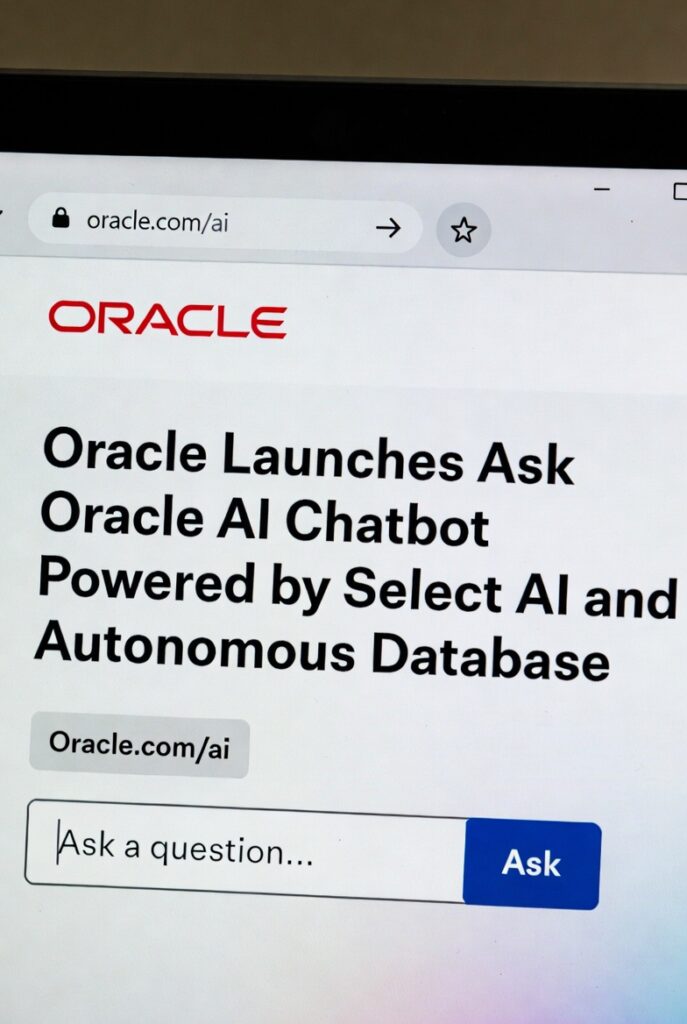
Oracle introduces a revolutionary AI-powered chatbot that transforms how users interact with databases and artificial intelligence. The Ask Oracle chatbot leverages Oracle’s cutting-edge Select AI technology and Autonomous AI Database to deliver conversational data access without requiring coding expertise. This breakthrough application democratizes database querying through natural language processing.
Understanding Ask Oracle: Enterprise AI Chatbot Solution
Oracle unveils Ask Oracle as a sample application built on Oracle APEX (Application Express). This innovative tool provides users with an intuitive chatbot interface that connects directly to large language models and enterprise databases.
The chatbot operates through Oracle’s Autonomous AI Database and Select AI technology. Consequently, both technical and non-technical users can query data, interact with AI models, and automate workflows using simple conversational language.
Moreover, organizations can deploy Ask Oracle immediately or customize it to meet specific business requirements. This flexibility makes the solution valuable across various industries and use cases.
Key Features of Ask Oracle Chatbot
Direct LLM Conversations
Users can engage in natural conversations with configured large language models through their selected AI profiles. The chatbot maintains context throughout discussions, enabling coherent multi-turn conversations.
Additionally, the system supports switching between different AI models seamlessly. This versatility allows users to leverage the most appropriate model for specific tasks.
Natural Language to SQL (NL2SQL)
The chatbot transforms plain English questions into executable SQL queries automatically. For instance, asking “show me last quarter’s top-selling products” generates and executes the appropriate database query.
Furthermore, users don’t need to understand database schemas or SQL syntax. The AI interprets intent and constructs queries that retrieve accurate results from Oracle Autonomous AI Database.
Retrieval Augmented Generation (RAG)
Ask Oracle implements RAG capabilities using vector indexes specified in AI profiles. This technology grounds AI responses in verified enterprise data sources rather than relying solely on pre-trained knowledge.
Consequently, organizations receive more accurate, contextually relevant answers based on their proprietary data. This feature proves particularly valuable for domain-specific queries requiring current, precise information.
AI Agent Integration
The chatbot supports interaction with AI agents for task-oriented workflows. Users can orchestrate complex, multi-step processes through simple conversational commands.
These agents automate end-to-end operations involving data retrieval, processing, and action execution. As a result, routine tasks become streamlined and efficient.
SQL Query Explanations
Ask Oracle generates human-readable explanations of SQL queries produced from natural language. Users can review these explanations to understand how the system interpreted their requests.
This transparency builds trust and helps users refine their questions for better results. Moreover, it serves as an educational tool for those learning database concepts.
Conversation Management
The application maintains long-term memory across multiple conversation threads. Users can create, manage, and edit separate conversations for different projects or topics.
Additionally, switching between conversation threads occurs instantly. This organization prevents context confusion and maintains clear separation between distinct workflows.
Data Visualization
Users can create and refine charts directly from query results through UI controls or natural language prompts. For example, requesting “produce a bar chart grouped by country for the top 5 countries” generates appropriate visualizations automatically.
Furthermore, the system supports multiple chart types and customization options. Visual data representation enhances comprehension and facilitates better decision-making.
Audio Response Generation
Ask Oracle includes text-to-speech functionality that converts written responses into audio. This accessibility feature benefits users who prefer auditory information consumption or require hands-free operation.
The audio generation maintains natural intonation and pacing for comfortable listening experiences.
Comprehensive Metadata Display
Users can view detailed information about AI profiles and agents directly within the interface. This transparency helps users understand which models and configurations power their interactions.
Additionally, each prompt displays which action, AI profile, or agent processed the request. This visibility supports troubleshooting and optimization efforts.
Oracle Autonomous AI Database Select AI Technology
What Makes Select AI Revolutionary
Select AI represents a powerful feature within Oracle’s Autonomous AI Database platform. This technology bridges the gap between natural language and database operations through advanced AI integration.
The system supports building AI-enabled applications that leverage LLMs and transformers from multiple providers. Organizations can utilize commercial AI services or deploy privately hosted models based on security and compliance requirements.
SQL, PL/SQL, and Python API Support
Developers access Select AI capabilities through familiar programming interfaces including SQL, PL/SQL, and Python APIs. This flexibility accommodates diverse development preferences and existing codebases.
Consequently, organizations can integrate AI capabilities into existing applications without major architectural changes. The technology fits naturally into established development workflows.
Natural Language Query Generation
Select AI excels at converting conversational questions into precise SQL queries. The system analyzes natural language input, interprets intent, and generates appropriate database commands.
For example, questions like “What were our highest revenue products last month?” automatically become properly structured SQL queries. The database executes these queries securely against authorized data sources.
Users can review generated SQL, request step-by-step explanations, execute queries automatically, or receive textual narrations of results. This flexibility supports various user skill levels and preferences.
Advanced RAG Implementation
Select AI implements Retrieval Augmented Generation using Oracle’s AI Vector Search technology. This approach delivers more accurate, context-aware answers by grounding AI responses in enterprise data.
Organizations index their proprietary documents, manuals, and data sources as vectors. When users ask questions, the system retrieves relevant information and incorporates it into AI-generated responses.
This methodology significantly improves accuracy compared to generic AI models lacking domain-specific knowledge.
Synthetic Data Generation
Beyond querying existing data, Select AI generates synthetic data for development and testing purposes. Organizations create realistic datasets without exposing sensitive production information.
This capability accelerates application development while maintaining data privacy and security. Development teams work with representative data that mimics production characteristics without compliance risks.
Text Processing Capabilities
Select AI handles various text processing tasks, including translation between languages and content summarization. These features enhance productivity by automating routine document processing workflows.
Users can quickly extract key insights from lengthy reports or communicate across language barriers without leaving the database environment.
AI Agent Orchestration
Select AI Agents enable building, orchestrating, and executing AI agents that automate complex workflows. These agents chain together multiple operations, make decisions based on data, and execute actions automatically.
Organizations deploy agents for tasks ranging from customer service automation to data pipeline management. The technology handles sophisticated logic while maintaining security and reliability.
Oracle APEX Integration Architecture
Low-Code Application Development
Oracle APEX provides a low-code platform for building scalable, data-driven web and mobile applications. Running natively within Autonomous AI Database, APEX enables declarative UI and workflow design.
The platform manages security, performance optimization, and lifecycle tasks automatically. Consequently, developers focus on business logic rather than infrastructure concerns.
Native Database Integration
APEX’s deep integration with Oracle Database features creates powerful synergies. Applications access SQL, REST APIs, AI Vector Search, and Select AI capabilities seamlessly.
This native integration eliminates complex middleware layers and reduces development complexity. Data-centric and AI-powered applications emerge quickly with minimal coding requirements.
Declarative Development Approach
APEX allows developers to design interfaces, workflows, and reports through visual tools rather than extensive coding. The platform generates optimized code automatically based on declarative specifications.
This approach significantly accelerates development cycles while maintaining application quality and performance standards.
Getting Started with Ask Oracle
Quick Setup Process
Deploying Ask Oracle requires minimal setup thanks to APEX’s built-in availability within the Autonomous AI Database. Organizations follow straightforward steps to launch the chatbot.
First, users create an APEX workspace within their Autonomous AI Database instance. Next, they use App Builder to import the Ask Oracle sample application provided by Oracle.
After installing supporting objects and configuring default AI profiles or agents, the application becomes operational. The entire process completes quickly without extensive infrastructure preparation.
Configuration Options
Organizations customize Ask Oracle to match their specific requirements. Custom AI profiles determine which language models power conversations and queries.
Additionally, administrators configure vector indexes for RAG implementations and set up AI agents for workflow automation. These configurations tailor the chatbot’s capabilities to organizational needs.
Step-by-Step Documentation
Oracle provides comprehensive quick-start videos and documentation for deployment. These resources guide users through installation, configuration, and initial usage.
Furthermore, the sample application includes best practices and example configurations. Organizations leverage these resources to accelerate time-to-value.
Real-World Business Applications
Business Intelligence and Analytics
Business analysts use Ask Oracle to query data without writing SQL queries manually. Questions like “what are our quarterly revenue trends by region?” generate appropriate analytics automatically.
This democratization of data access empowers more employees to make data-driven decisions. Organizations unlock insights previously restricted to technical specialists.
Customer Service Enhancement
Customer service representatives access customer data and order information through conversational queries. The chatbot retrieves relevant information quickly, improving response times and service quality.
Moreover, AI agents can automate routine customer inquiries, freeing human agents for complex issues requiring personal attention.
Financial Reporting Automation
Finance teams generate reports and analyze financial data through natural language requests. The system pulls data from multiple sources, performs calculations, and presents results in preferred formats.
This automation reduces manual report creation time while improving accuracy and consistency.
Operational Monitoring
Operations teams monitor key performance indicators by asking questions about system status, inventory levels, or production metrics. The chatbot provides real-time insights without requiring dashboard navigation.
Consequently, teams identify and respond to issues more quickly, improving operational efficiency.
Data Science and ML Operations
Data scientists explore datasets, test hypotheses, and validate models through conversational queries. The chatbot accelerates exploratory data analysis by eliminating repetitive coding tasks.
Additionally, AI agents can automate model training pipelines and deployment workflows, streamlining machine learning operations.
Security and Governance Features
Enterprise-Grade Security
Ask Oracle operates within Oracle’s Autonomous AI Database security framework. All queries execute with appropriate access controls and authentication mechanisms.
The system maintains comprehensive audit trails of all interactions and data access. Organizations track who accessed what information and when, supporting compliance requirements.
Role-Based Access Control
Administrators configure granular permissions, determining which users can access specific data sources and AI capabilities. This fine-grained control prevents unauthorized data exposure.
Furthermore, the system integrates with enterprise identity management solutions for seamless authentication and authorization.
Data Privacy Protection
Organizations maintain complete control over data used in AI interactions. Information never leaves the database environment without explicit authorization.
This architecture addresses data sovereignty and privacy concerns common in cloud AI implementations. Sensitive data remains within organizational boundaries while still enabling advanced AI capabilities.
Customization and Extension Possibilities
UI Customization
Organizations modify the chatbot interface to match corporate branding and user experience requirements. APEX’s flexibility supports extensive visual customization without coding.
Companies can add custom features, integrate additional data sources, or modify workflows to align with specific business processes.
AI Model Integration
Ask Oracle supports connecting to various AI providers and models. Organizations choose models based on performance requirements, cost considerations, and feature needs.
This flexibility prevents vendor lock-in while enabling optimization for specific use cases. Companies can experiment with different models and select optimal solutions.
Workflow Automation
Developers extend Ask Oracle with custom AI agents that automate complex organizational workflows. These agents integrate with external systems, trigger business processes, and coordinate multi-step operations.
The extensibility supports evolving business requirements without replacing the core chatbot infrastructure.
Performance and Scalability
Cloud-Native Architecture
Running on Oracle’s cloud infrastructure, Ask Oracle scales automatically based on demand. The system handles increasing query volumes without manual intervention or performance degradation.
Organizations avoid capacity planning challenges while ensuring consistent user experiences during peak usage periods.
Optimized Query Execution
Oracle’s database optimization technologies ensure that generated SQL queries execute efficiently. The system leverages indexes, caching, and query optimization automatically.
Consequently, users receive rapid responses even when querying large datasets or complex data relationships.
Concurrent User Support
The architecture supports multiple simultaneous users without resource conflicts. Each conversation maintains an independent context while sharing underlying infrastructure efficiently.
This capability makes Ask Oracle suitable for enterprise-wide deployment across large organizations.
Comparison with Alternative Solutions
Traditional BI Tools
Unlike conventional business intelligence platforms requiring extensive training, Ask Oracle provides instant accessibility through natural language. Users ask questions naturally rather than constructing complex reports.
However, traditional BI tools may offer more sophisticated visualization capabilities for specialized analytical needs. Organizations might use both complementary approaches.
Standalone Chatbot Platforms
Generic chatbot solutions lack deep database integration and enterprise AI capabilities. Ask Oracle’s tight coupling with Oracle’s database and AI technologies delivers superior performance and capabilities.
Moreover, the solution provides enterprise-grade security, scalability, and governance features often absent in standalone chatbot products.
Custom Development Approaches
Building equivalent functionality from scratch requires substantial development effort and ongoing maintenance. Ask Oracle provides ready-to-use capabilities while allowing customization as needed.
This approach significantly reduces time-to-value and total cost of ownership compared to custom development projects.
Future Development and Roadmap
Continuous Enhancement
Oracle actively develops additional capabilities for Select AI and Ask Oracle. Regular updates deliver new features, performance improvements, and expanded integration options.
The technology evolves based on customer feedback and emerging AI capabilities. Organizations benefit from ongoing innovation without migration efforts.
Expanding AI Model Support
Future releases will likely support additional AI models and providers as the ecosystem matures. This flexibility ensures organizations have access to cutting-edge capabilities as they emerge.
Enhanced Automation Capabilities
Expect more sophisticated AI agent capabilities enabling increasingly complex workflow automation. These advancements will further reduce manual effort across various business processes.