
GPT-5.4 mini and GPT-5.4 nano. Artificial intelligence is evolving rapidly, but bigger does not always mean better. In many real-world applications, speed, efficiency, and cost matter just as much as raw intelligence. Recognizing this need, OpenAI has introduced GPT-5.4 mini and GPT-5.4 nano, two compact yet powerful AI models designed to deliver strong performance while remaining fast and affordable.
These new models represent a shift in AI development philosophy. Instead of focusing only on large, resource-heavy systems, OpenAI is now investing in smaller models that can handle practical, everyday workloads efficiently. From coding assistants and automation tools to document processing and multimodal applications, these models aim to make AI more usable at scale.
A New Generation of Efficient AI Models
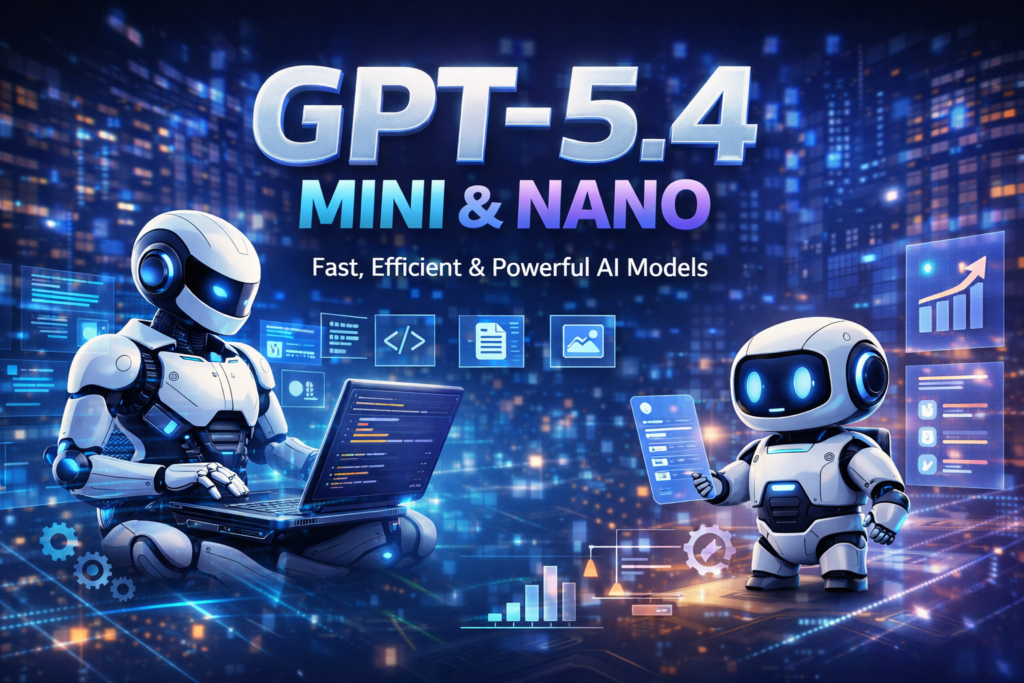
GPT-5.4 mini and nano build upon the capabilities of the GPT-5.4 family while focusing on performance efficiency. The goal is simple: deliver strong reasoning, coding ability, and multimodal understanding while reducing cost and latency. GPT-5.4 mini and GPT-5.4 nano
GPT-5.4 mini, in particular, is positioned as a major improvement over GPT-5 mini. According to OpenAI benchmarks, it performs significantly better in areas such as:
- Coding accuracy
- Reasoning ability
- Tool usage
- Multimodal understanding
- Workflow automation
At the same time, it operates more than twice as fast in many scenarios. This combination of speed and capability makes it especially useful for developers and businesses that rely on fast responses. GPT-5.4 mini and GPT-5.4 nano
GPT-5.4 nano, on the other hand, is designed for situations where cost and speed are the highest priorities. It is the smallest and most economical model in the GPT-5.4 lineup. While it is not intended for deep reasoning tasks, it performs very well in structured tasks such as:
- Data classification
- Information extraction
- Ranking tasks
- Supporting coding operations
- Automation subtasks
In simple terms, if GPT-5.4 is the strategist and GPT-5.4 mini is the engineer, GPT-5.4 nano acts like a fast assistant handling repetitive or supporting tasks.
Why Smaller AI Models Matter More Than Ever
Traditionally, AI progress was measured by model size. Larger models often meant better performance. However, real-world usage has shown that responsiveness often matters more than size. GPT-5.4 mini and GPT-5.4 nano
For example:
A coding assistant that takes 30 seconds to respond may be technically impressive, but developers prefer one that responds in 3 seconds. Similarly, automation systems that process thousands of small tasks need efficiency more than maximum reasoning depth. GPT-5.4 mini and GPT-5.4 nano
This is where GPT-5.4 mini and nano become important. They are built for environments where:
- Response speed affects user experience
- Costs must remain predictable
- Tasks are frequent but smaller in scope
- Systems need reliable automation support
OpenAI describes this as performance per latency rather than just performance alone. GPT-5.4 mini and GPT-5.4 nano
Strong Performance in Coding Workflows
One of the strongest use cases for GPT-5.4 mini is software development. Modern development increasingly depends on AI tools for writing, reviewing, debugging, and optimizing code. GPT-5.4 mini and GPT-5.4 nano
GPT-5.4 mini performs particularly well in:
- Code editing
- Debugging loops
- Front-end generation
- Repository navigation
- Documentation processing
Benchmarks such as SWE-Bench Pro show that GPT-5.4 mini approaches GPT-5.4 performance levels while remaining significantly faster. This makes it ideal for environments where developers need continuous AI assistance without delays.
The model also shows strong performance in terminal-based tasks and tool-calling benchmarks, which indicates its usefulness in real engineering environments rather than just theoretical testing.
The Rise of AI Subagents
Another important concept highlighted with GPT-5.4 mini is the idea of AI subagents.
Instead of relying on one large AI model to do everything, modern AI systems increasingly use multiple specialized models working together. In this approach:
- A large model handles planning and decision-making
- Smaller models execute specific tasks quickly
- Results are combined for efficiency
For example, in a coding system:
A large model might decide how to refactor a project. GPT-5.4 mini subagents might then:
- Scan files
- Check dependencies
- Review documentation
- Run quick checks
This layered approach improves both speed and cost efficiency.
As smaller models become more capable, this architecture is expected to become standard in enterprise AI systems.
Improvements in Multimodal and Computer Use Tasks
GPT-5.4 mini also shows strong performance in multimodal tasks, especially those involving computer interfaces.
This includes the ability to:
- Understand screenshots
- Interpret UI layouts
- Process visual information
- Assist in computer automation
These capabilities are important because many modern AI applications involve interacting with software environments rather than just text.
For example:
AI tools that assist with customer support dashboards, design software, or data analysis platforms must understand visual interfaces. GPT-5.4 mini’s improvements in this area suggest that smaller AI models are becoming capable of handling complex real-world interactions.
Availability and Pricing
OpenAI has made GPT-5.4 mini widely available across multiple platforms.
It is currently available in:
- OpenAI API
- Codex environments
- ChatGPT (via Thinking feature)
- Developer tools and integrations
The model supports:
- Text input
- Image input
- Tool usage
- Function calling
- File search
- Web search
- Computer interaction
It also features a large 400k context window, allowing it to process large documents and workflows efficiently.
From a pricing perspective, GPT-5.4 mini is designed to remain accessible. OpenAI lists pricing around:
- $0.75 per million input tokens
- $4.50 per million output tokens
GPT-5.4 nano is even cheaper:
- $0.20 per million input tokens
- $1.25 per million output tokens
This pricing structure makes it possible to deploy AI systems at scale without excessive operational costs.
Practical Use Cases for Businesses
The introduction of GPT-5.4 mini and nano opens new possibilities for businesses seeking practical AI integration.
Some strong use cases include:
Customer Support Automation
Companies can use nano models to categorize tickets while mini models generate responses.
Document Processing
Nano can extract data while mini verifies and summarizes information.
Coding Support
Mini can assist developers while nano handles simple checks.
Workflow Automation
Multiple nano agents can process routine tasks while a mini model coordinates outputs.
Data Analysis Pipelines
Nano models can clean and structure data before mini models interpret it.
These examples show how AI systems are moving toward collaborative model ecosystems rather than single monolithic models.
Performance Benchmarks and Intelligence Metrics
Benchmark comparisons show consistent improvements over previous mini models.
GPT-5.4 mini demonstrates stronger results in:
- SWE-Bench coding tests
- Tool interaction benchmarks
- Intelligence evaluations
- Multimodal understanding tests
While GPT-5.4 remains the top performer overall, GPT-5.4 mini offers one of the best efficiency-to-performance ratios currently available.
GPT-5.4 nano also shows meaningful improvements over GPT-5 nano, especially in classification and structured reasoning tasks.
These improvements suggest that AI optimization is becoming just as important as AI scaling.
The Future of AI: Smart Systems, Not Just Big Models
The release of GPT-5.4 mini and nano reflects a broader industry trend. The future of AI may not be defined by a single massive model but by networks of specialized models working together.
This mirrors how human organizations operate. A company does not rely on one person to do everything. Instead, leaders plan, specialists execute, and assistants support.
AI is now following the same pattern.
The benefits of this approach include:
- Lower costs
- Faster response times
- Better scalability
- Improved reliability
- Modular system design
As businesses adopt AI more deeply, this modular model ecosystem could become the dominant architecture.
Final Thoughts
GPT-5.4 mini and GPT-5.4 nano demonstrate that AI progress is no longer just about building bigger systems. It is about building smarter systems.
By focusing on efficiency, responsiveness, and practical deployment, OpenAI is addressing the real needs of developers and businesses. These models show that smaller AI can still deliver strong intelligence while being fast enough for real-time use.
For developers, these models offer a balance between capability and cost. For businesses, they provide scalable automation tools. For the AI ecosystem, they represent a move toward more collaborative, layered AI architectures.
As AI continues to mature, models like GPT-5.4 mini and nano may become the backbone of everyday intelligent systems — quietly powering the tools people rely on every day.
Pingback: 6 Benefits Of Free Online Tools – Uses And Advantages Explained