
OpenAI strategic reset signals a major shift toward business AI, coding tools, and enterprise users. Learn why OpenAI paused ChatGPT’s erotic mode and other projects.More importantly, this move signals a broader transformation within the AI industry itself. Instead of focusing on experimental or controversial features, companies are increasingly concentrating on enterprise solutions, coding tools, and defense-related technologies.
The Rise and Fall of ChatGPT’s “Adult Mode”
Initially, OpenAI’s leadership explored the idea of introducing an adult or erotic mode as part of ChatGPT’s expanding capabilities. CEO Sam Altman reportedly mentioned the concept in late 2025 as part of a broader discussion about allowing more flexible content boundaries within AI systems.
However, almost immediately, the proposal generated controversy.
Critics argued that such a feature could introduce ethical risks and reputational damage. Technology watchdog groups questioned whether OpenAI could responsibly manage the safety implications of adult content generation. At the same time, internal discussions reportedly became tense. Some advisors warned that without strict controls, such features could produce harmful or psychologically dangerous interactions.
For example, concerns emerged about the possibility of AI systems unintentionally encouraging harmful emotional dependencies. These fears intensified debates about whether AI should simulate intimate or emotionally sensitive conversations at all.
As a result, OpenAI delayed the feature multiple times. Eventually, the company decided to pause development indefinitely. Notably, the company did not cancel the feature outright, which suggests that the idea may return in the future if safety frameworks improve.
A Pattern of Strategic Refocusing
Interestingly, the pause of the erotic mode did not happen in isolation. Instead, it formed part of a larger pattern of OpenAI narrowing its priorities.
Within the same week, the company also reduced its focus on another experimental feature called Instant Checkout. This tool aimed to turn ChatGPT into an e-commerce purchasing assistant, allowing users to buy products directly through conversations. Although the concept sounded promising, OpenAI appears to have decided that the feature did not align closely enough with its core strategic goals.
Furthermore, the company announced the shutdown of Sora, its AI video generation project. Sora had attracted attention for its ability to create realistic videos from text prompts. Nevertheless, critics argued that such tools contributed to the growing flood of low-quality AI content online, often described as “AI slop.”
Taken together, these decisions suggest that OpenAI is deliberately cutting side projects to concentrate on fewer, higher-impact initiatives.
The Real Reason: A Major Strategy Shift
According to reports, OpenAI’s recent decisions connect to a broader strategy change. The company now appears determined to focus on two main customer groups:
First, business users.
Second, software developers and coders.
This makes sense from a financial perspective. Enterprise AI tools generate predictable revenue, while experimental consumer features often carry reputational risks without guaranteed returns.
Moreover, competition has intensified dramatically. Companies such as Anthropic have released advanced AI tools specifically designed for coding and business productivity. These tools directly compete with OpenAI’s enterprise offerings.
Consequently, OpenAI likely recognized the need to strengthen its position in areas that deliver measurable value rather than experimenting with features that might generate controversy.
Competitive Pressure From Rivals
At the same time, competition within the AI sector continues to accelerate. Rival companies are moving quickly, releasing new capabilities and targeting lucrative enterprise markets.
Anthropic, for example, has built strong momentum by focusing heavily on coding assistance and professional AI applications. By prioritizing practical business use cases, competitors have managed to attract corporate customers seeking productivity gains rather than entertainment features. OpenAI strategic reset
Therefore, OpenAI may feel increasing pressure to respond strategically. By concentrating resources on enterprise tools and developer ecosystems, the company can better defend its leadership position.
In other words, this shift is not just about removing distractions. Instead, it reflects the growing maturity of the AI industry. As the market evolves, companies must demonstrate clear economic value rather than simply showcasing technological novelty. OpenAI strategic reset
The Growing Importance of Defense and Government Contracts
Another important factor involves government partnerships. Recently, OpenAI secured a significant contract reportedly worth hundreds of millions of dollars with the U.S. Department of Defense. Such agreements represent not only financial opportunities but also strategic influence.
Government contracts typically require strict compliance, reliability, and safety standards. Therefore, companies working in this space often avoid features that could create reputational risks or public controversy. OpenAI strategic reset
This reality may also explain why OpenAI chose to deprioritize experimental features. By focusing on enterprise and government applications, the company strengthens its credibility as a serious infrastructure provider rather than a consumer novelty platform.
Meanwhile, rivals are also pursuing similar opportunities. Competition for defense and government partnerships may shape the next phase of AI development just as much as consumer innovation.
A Turning Point for AI Priorities
Taken together, these developments point toward an important conclusion. The AI industry appears to be entering a new phase.
In the early years of generative AI, companies focused heavily on viral features. Image generators, meme creators, and entertainment tools attracted attention and demonstrated technological progress. However, as the market matures, priorities are shifting. OpenAI strategic reset
Today, companies increasingly prioritize:
Enterprise productivity
Software development
Automation tools
Government partnerships
Infrastructure platforms
This evolution mirrors the history of previous technology waves. For example, early internet companies often focused on experimental or entertainment products. Later, the most successful firms concentrated on infrastructure, enterprise services, and scalable platforms.
AI seems to be following a similar trajectory. OpenAI strategic reset
Risk Management and Brand Protection
Another important factor involves brand management. As AI companies grow, they face increased scrutiny from regulators, journalists, and the public.
Controversial features can damage trust, even if they demonstrate technical capability. Therefore, companies must carefully balance innovation with responsibility.
By pausing the erotic mode, OpenAI may be signaling that it prefers to avoid unnecessary controversy while regulators continue developing AI governance frameworks.
Additionally, enterprise customers typically prefer working with companies that demonstrate stability and professionalism. Removing potentially controversial features helps reinforce that image. OpenAI strategic reset
The Changing Definition of AI Success
These developments also raise an important question: how should success in AI be measured?
In the past, success often meant building the most impressive demos or the most viral tools. Today, however, success increasingly depends on reliability, integration, and measurable business impact.
For example, companies now evaluate AI based on:
How much time it saves employees
How well it integrates into workflows
How securely it handles data
How effectively it supports decision-making
This shift reflects a deeper reality. AI is no longer just a novelty. Instead, it is becoming core infrastructure.
What This Means for Users
For everyday users, these changes may lead to fewer experimental features but more practical tools. Instead of entertainment-focused upgrades, future improvements may focus on productivity, coding assistance, and professional applications. OpenAI strategic reset
For example, users may see:
Better document analysis
Stronger coding assistance
Improved research tools
Enhanced automation features
More reliable enterprise integrations
Although some users may miss experimental features, others may benefit from more stable and useful systems. OpenAI strategic reset
The Future of AI Development
Looking forward, OpenAI’s decisions may reflect a broader industry trend. AI companies increasingly recognize that long-term success depends on trust, reliability, and economic value.
Therefore, the next wave of AI innovation will likely focus less on novelty and more on impact. Instead of chasing viral attention, companies may prioritize building essential tools that businesses depend on every day.
At the same time, competition will continue to drive rapid innovation. As rivals release new capabilities, companies must carefully decide where to invest their resources.
In this environment, strategic discipline becomes just as important as technological advancement. OpenAI strategic reset
Conclusion
OpenAI’s decision to pause ChatGPT’s erotic mode may seem minor at first glance. However, it actually represents something much larger. The company is narrowing its focus, reducing distractions, and aligning itself with enterprise and government opportunities.
At the same time, growing competition and increasing regulatory attention are pushing AI companies toward more disciplined strategies.
Ultimately, these developments suggest that the future of AI will likely focus less on experimental entertainment features and more on serious applications in business, software development, and national infrastructure. OpenAI strategic reset
In other words, the AI race is no longer just about building the most impressive technology. Instead, it is about building the most useful, trusted, and economically valuable systems.
And if recent developments are any indication, the next chapter of AI will be defined not by novelty—but by necessity.
OpenAI has once again demonstrated that even the most ambitious AI companies must constantly adjust their priorities. Recently, the company decided to indefinitely pause development of an “erotic mode” for ChatGPT, a feature that had already sparked internal debate and external criticism. While this decision may seem like a minor product adjustment, it actually reveals something much bigger: a major strategic shift in how OpenAI sees the future of artificial intelligence. OpenAI strategic reset
More importantly, this move signals a broader transformation within the AI industry itself. Instead of focusing on experimental or controversial features, companies are increasingly concentrating on enterprise solutions, coding tools, and defense-related technologies.
The Rise and Fall of ChatGPT’s “Adult Mode”
Initially, OpenAI’s leadership explored the idea of introducing an adult or erotic mode as part of ChatGPT’s expanding capabilities. CEO Sam Altman reportedly mentioned the concept in late 2025 as part of a broader discussion about allowing more flexible content boundaries within AI systems.
However, almost immediately, the proposal generated controversy.
Critics argued that such a feature could introduce ethical risks and reputational damage. Technology watchdog groups questioned whether OpenAI could responsibly manage the safety implications of adult content generation. At the same time, internal discussions reportedly became tense. Some advisors warned that without strict controls, such features could produce harmful or psychologically dangerous interactions. OpenAI strategic reset
For example, concerns emerged about the possibility of AI systems unintentionally encouraging harmful emotional dependencies. These fears intensified debates about whether AI should simulate intimate or emotionally sensitive conversations at all.
As a result, OpenAI delayed the feature multiple times. Eventually, the company decided to pause development indefinitely. Notably, the company did not cancel the feature outright, which suggests that the idea may return in the future if safety frameworks improve.
A Pattern of Strategic Refocusing
Interestingly, the pause of the erotic mode did not happen in isolation. Instead, it formed part of a larger pattern of OpenAI narrowing its priorities.
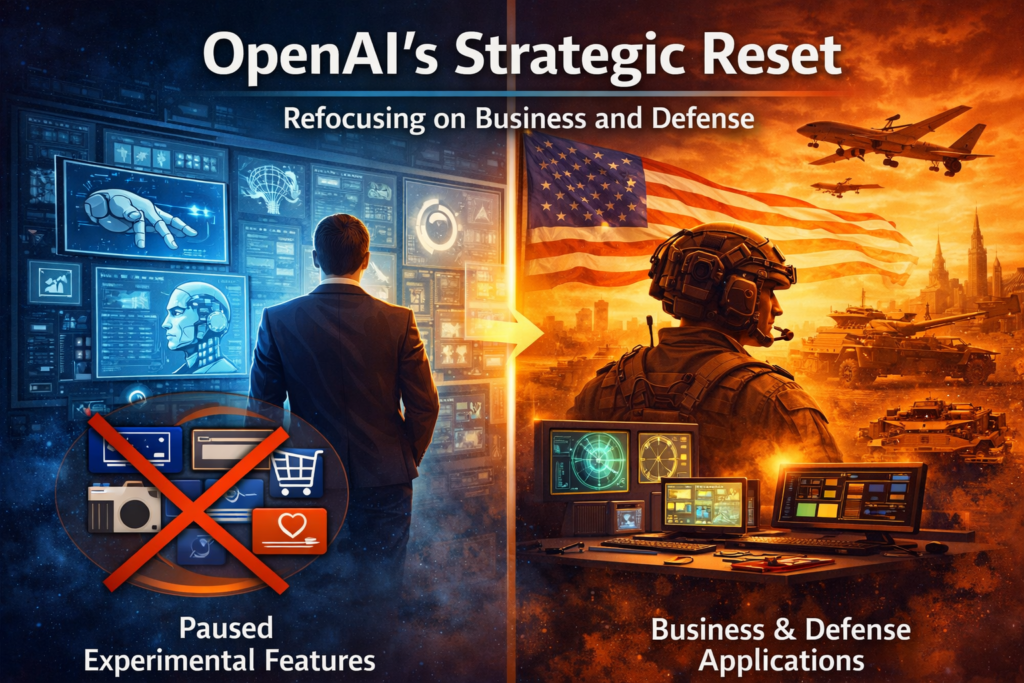
Within the same week, the company also reduced its focus on another experimental feature called Instant Checkout. This tool aimed to turn ChatGPT into an e-commerce purchasing assistant, allowing users to buy products directly through conversations. Although the concept sounded promising, OpenAI appears to have decided that the feature did not align closely enough with its core strategic goals.
Furthermore, the company announced the shutdown of Sora, its AI video generation project. Sora had attracted attention for its ability to create realistic videos from text prompts. Nevertheless, critics argued that such tools contributed to the growing flood of low-quality AI content online, often described as “AI slop.” OpenAI strategic reset
Taken together, these decisions suggest that OpenAI is deliberately cutting side projects to concentrate on fewer, higher-impact initiatives.
The Real Reason: A Major Strategy Shift
According to reports, OpenAI’s recent decisions connect to a broader strategy change. The company now appears determined to focus on two main customer groups: OpenAI strategic reset
First, business users.
Second, software developers and coders.
This makes sense from a financial perspective. Enterprise AI tools generate predictable revenue, while experimental consumer features often carry reputational risks without guaranteed returns.
Moreover, competition has intensified dramatically. Companies such as Anthropic have released advanced AI tools specifically designed for coding and business productivity. These tools directly compete with OpenAI’s enterprise offerings.
Consequently, OpenAI likely recognized the need to strengthen its position in areas that deliver measurable value rather than experimenting with features that might generate controversy.
Competitive Pressure From Rivals
At the same time, competition within the AI sector continues to accelerate. Rival companies are moving quickly, releasing new capabilities and targeting lucrative enterprise markets.
Anthropic, for example, has built strong momentum by focusing heavily on coding assistance and professional AI applications. By prioritizing practical business use cases, competitors have managed to attract corporate customers seeking productivity gains rather than entertainment features.
Therefore, OpenAI may feel increasing pressure to respond strategically. By concentrating resources on enterprise tools and developer ecosystems, the company can better defend its leadership position.
In other words, this shift is not just about removing distractions. Instead, it reflects the growing maturity of the AI industry. As the market evolves, companies must demonstrate clear economic value rather than simply showcasing technological novelty. OpenAI strategic reset
The Growing Importance of Defense and Government Contracts
Another important factor involves government partnerships. Recently, OpenAI secured a significant contract reportedly worth hundreds of millions of dollars with the U.S. Department of Defense. Such agreements represent not only financial opportunities but also strategic influence.
Government contracts typically require strict compliance, reliability, and safety standards. Therefore, companies working in this space often avoid features that could create reputational risks or public controversy.
This reality may also explain why OpenAI chose to deprioritize experimental features. By focusing on enterprise and government applications, the company strengthens its credibility as a serious infrastructure provider rather than a consumer novelty platform.
Meanwhile, rivals are also pursuing similar opportunities. Competition for defense and government partnerships may shape the next phase of AI development just as much as consumer innovation. OpenAI strategic reset
A Turning Point for AI Priorities
Taken together, these developments point toward an important conclusion. The AI industry appears to be entering a new phase.
In the early years of generative AI, companies focused heavily on viral features. Image generators, meme creators, and entertainment tools attracted attention and demonstrated technological progress. However, as the market matures, priorities are shifting.
Today, companies increasingly prioritize: OpenAI strategic reset
Enterprise productivity
Software development
Automation tools
Government partnerships
Infrastructure platforms
This evolution mirrors the history of previous technology waves. For example, early internet companies often focused on experimental or entertainment products. Later, the most successful firms concentrated on infrastructure, enterprise services, and scalable platforms.
AI seems to be following a similar trajectory.
Risk Management and Brand Protection
Another important factor involves brand management. As AI companies grow, they face increased scrutiny from regulators, journalists, and the public.
Controversial features can damage trust, even if they demonstrate technical capability. Therefore, companies must carefully balance innovation with responsibility.
By pausing the erotic mode, OpenAI may be signaling that it prefers to avoid unnecessary controversy while regulators continue developing AI governance frameworks. OpenAI strategic reset
Additionally, enterprise customers typically prefer working with companies that demonstrate stability and professionalism. Removing potentially controversial features helps reinforce that image. OpenAI strategic reset
The Changing Definition of AI Success
These developments also raise an important question: how should success in AI be measured?
In the past, success often meant building the most impressive demos or the most viral tools. Today, however, success increasingly depends on reliability, integration, and measurable business impact. OpenAI strategic reset
For example, companies now evaluate AI based on:
How much time it saves employees
How well it integrates into workflows
How securely it handles data
How effectively it supports decision-making
This shift reflects a deeper reality. AI is no longer just a novelty. Instead, it is becoming core infrastructure. OpenAI strategic reset
What This Means for Users
For everyday users, these changes may lead to fewer experimental features but more practical tools. Instead of entertainment-focused upgrades, future improvements may focus on productivity, coding assistance, and professional applications. OpenAI strategic reset
For example, users may see:
Better document analysis
Stronger coding assistance
Improved research tools
Enhanced automation features
More reliable enterprise integrations
Although some users may miss experimental features, others may benefit from more stable and useful systems.
The Future of AI Development
Looking forward, OpenAI’s decisions may reflect a broader industry trend. AI companies increasingly recognize that long-term success depends on trust, reliability, and economic value.
Therefore, the next wave of AI innovation will likely focus less on novelty and more on impact. Instead of chasing viral attention, companies may prioritize building essential tools that businesses depend on every day.
At the same time, competition will continue to drive rapid innovation. As rivals release new capabilities, companies must carefully decide where to invest their resources.
In this environment, strategic discipline becomes just as important as technological advancement.
Conclusion
OpenAI’s decision to pause ChatGPT’s erotic mode may seem minor at first glance. However, it actually represents something much larger. The company is narrowing its focus, reducing distractions, and aligning itself with enterprise and government opportunities.
At the same time, growing competition and increasing regulatory attention are pushing AI companies toward more disciplined strategies.
Ultimately, these developments suggest that the future of AI will likely focus less on experimental entertainment features and more on serious applications in business, software development, and national infrastructure.
In other words, the AI race is no longer just about building the most impressive technology. Instead, it is about building the most useful, trusted, and economically valuable systems.
And if recent developments are any indication, the next chapter of AI will be defined not by novelty—but by necessity.
Boost your content creation workflow with powerful tools.
Discover the best AI and digital creator tools to write faster, design better, and grow your online presence.
👉 Explore Content Creation Tools Now: Content Creation Tools