

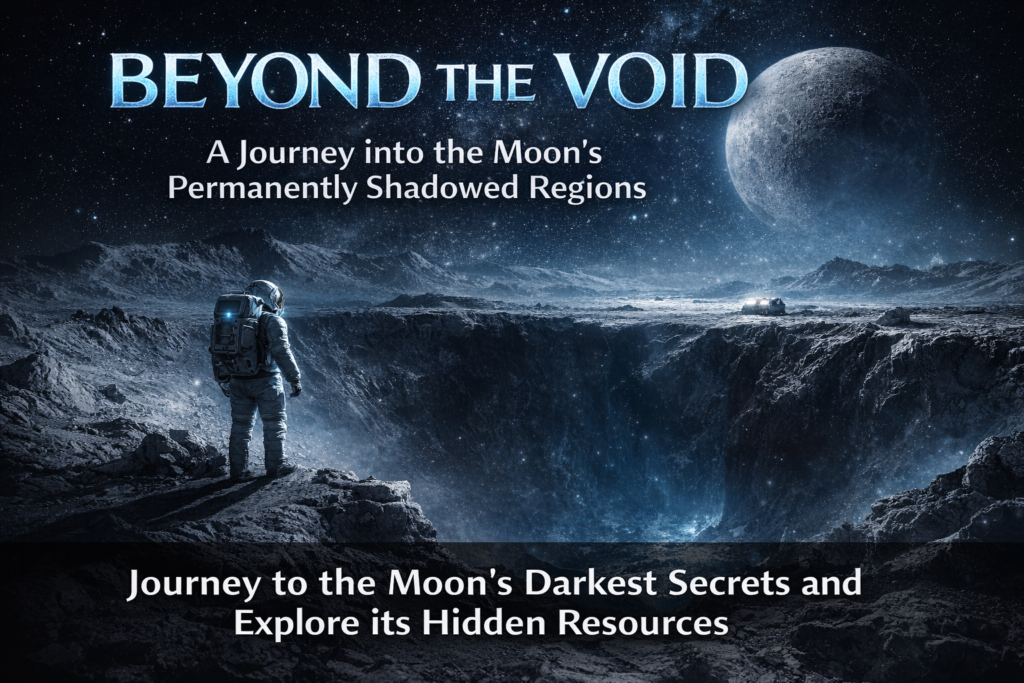
Moon Permanently Shadowed Regions. For centuries, the Moon has fascinated humanity as a symbol of mystery, beauty, and exploration. From ancient myths to modern space missions, our closest celestial neighbor continues to reveal secrets that challenge our understanding of space. Among its most mysterious features are the Moon’s Permanently Shadowed Regions (PSRs) — areas so cold, dark, and isolated that sunlight has not touched them for billions of years. These regions represent one of the most intriguing scientific frontiers in modern space exploration. Moon Permanently Shadowed Regions
The Eternal Darkness on the Moon
Unlike Earth, the Moon has almost no axial tilt, only about 1.5 degrees compared to Earth’s 23.5 degrees. Because of this, sunlight strikes the Moon’s poles at very shallow angles. Deep craters near the north and south poles have walls that permanently block sunlight from reaching their interiors. These areas remain in complete darkness, creating what scientists call permanently shadowed regions.
Temperatures in these regions can drop below –230°C (–382°F), making them some of the coldest places in the entire solar system — even colder than Pluto in some cases. Because they are shielded from solar radiation, these craters act like natural deep freezers preserving ancient materials. Moon Permanently Shadowed Regions
Scientists believe these frozen environments may contain water ice, frozen gases, and possibly organic molecules that have remained untouched for billions of years. Moon Permanently Shadowed Regions
Why Permanently Shadowed Regions Matter
At first glance, dark frozen craters might seem unimportant, but PSRs may hold the key to the future of space exploration.
One of the most important discoveries of recent decades is the strong evidence of water ice trapped inside these regions. Missions like NASA’s Lunar Reconnaissance Orbiter (LRO), India’s Chandrayaan-1, and Chandrayaan-3 have provided valuable data suggesting significant ice deposits at the lunar poles. Moon Permanently Shadowed Regions
Water on the Moon changes everything.
Water can be:
- Converted into drinking water for astronauts
- Broken into hydrogen and oxygen for rocket fuel
- Used to produce breathable oxygen
- Used for radiation shielding in lunar habitats
This means PSRs could become resource hubs for future Moon bases and deep-space missions.
Instead of carrying all supplies from Earth, future astronauts might use Moon resources — a concept known as In-Situ Resource Utilization (ISRU). This could dramatically reduce the cost of space exploration. Moon Permanently Shadowed Regions
Scientific Treasure Frozen in Time
Permanently shadowed regions are also important because they may preserve the history of the solar system. Moon Permanently Shadowed Regions
Because these craters have remained undisturbed for billions of years, they may contain:
- Comet impacts are frozen in ice
- Solar wind particles trapped in regolith
- Ancient asteroid materials
- Possible prebiotic chemical compounds
Studying these materials could help scientists understand how water arrived in the Earth-Moon system and whether comets delivered organic compounds that contributed to the origin of life on Earth. Moon Permanently Shadowed Regions
These craters function like cosmic time capsules.
The Challenge of Exploring Eternal Night
Exploring PSRs is extremely difficult. These regions present engineering challenges never faced before.
Some of the biggest challenges include:
1. Extreme Cold
Electronics usually cannot operate at such low temperatures. Special insulation and nuclear or advanced battery systems may be required.
2. No Sunlight
Solar panels cannot function in permanent darkness. This forces missions to depend on alternative energy systems such as:
- Nuclear power units
- Laser power transmission
- Reflective mirror systems
- Advanced long-life batteries
3. Communication Problems
Deep craters can block radio signals. Missions may require relay satellites or communication towers placed on crater rims.
4. Dangerous Terrain
These regions may contain sharp rocks, loose soil, and steep slopes. Autonomous navigation technology is essential.
5. Limited Visibility
Robots must rely on lidar, infrared imaging, and radar instead of cameras.
Because of these obstacles, exploring PSRs is often compared to exploring deep ocean trenches on Earth — but with even more extreme conditions. Moon Permanently Shadowed Regions
Robots: The First Explorers of the Shadows
Before humans enter these dark regions, robots will lead the way.
Future exploration concepts include:
- Ice-drilling robots
- Hopper robots that jump between shadowed zones
- Tethered rovers connected to power stations
- Cryogenic sample collectors
- AI-guided autonomous mapping vehicles
NASA has proposed concepts such as the VIPER rover (Volatiles Investigating Polar Exploration Rover), designed specifically to map water ice distribution.
India is also positioning itself as a major contributor to lunar polar research after the success of Chandrayaan-3, which demonstrated precision landing capability near the south pole region.
The next generation of missions may specifically target PSRs directly. Moon Permanently Shadowed Regions
The Gateway to a Lunar Economy
If ice deposits are confirmed in large quantities, PSRs may become the foundation of a future lunar economy.
Possible future industries include:
- Fuel production depots
- Space manufacturing bases
- Research stations
- Deep space mission launch platforms
- Tourism infrastructure
- Scientific observatories
The Moon could become a refuelling station for Mars missions.
Since the Moon’s gravity is only one-sixth of Earth’s, launching spacecraft from there requires much less fuel. If rocket propellant can be produced from lunar ice, the Moon could serve as a staging point for missions deeper into the solar system. Moon Permanently Shadowed Regions
Ethical and Environmental Questions
As interest in PSRs grows, new questions arise.
Should humanity mine the Moon?
Should permanently shadowed regions be protected as scientific preserves?
Who owns lunar resources?
The Outer Space Treaty of 1967 states that no nation owns the Moon, but it does not fully define commercial extraction rights. As private companies and nations prepare for lunar mining, international cooperation will become essential.
There are also planetary protection concerns. If these regions contain pristine materials from the early solar system, contamination must be avoided.
Future missions may need strict protocols similar to those used in Antarctic research zones.
A New Space Race Focused on the Poles
The next phase of lunar exploration is shifting toward the poles.
Major programs include:
- NASA Artemis Program aiming for sustained human presence
- ESA lunar exploration initiatives
- ISRO future lunar missions
- China’s International Lunar Research Station plans
Unlike the Cold War space race, this new competition focuses on sustainability and long-term presence rather than symbolic landings.
The country that masters polar resource extraction may shape the future of human expansion into space.
What Humans Might Find in the Darkness
The most exciting possibility is that PSRs may contain surprises we have not yet imagined.
Scientists speculate these regions could contain:
- Unknown mineral formations
- Unusual ice chemistry
- Rare isotopes
- Complex carbon molecules
- Evidence of early solar radiation cycles
Every mission into these regions may rewrite textbooks.
Exploration of PSRs represents not just technological progress but also humanity’s drive to explore the unknown.
The Psychological Dimension of Eternal Darkness
Another overlooked factor is the psychological challenge.
Humans evolved under sunlight. Operating in regions where the Sun never rises may require new approaches to astronaut mental health.
Future lunar bases may use:
- Artificial daylight simulation
- Circadian rhythm lighting
- Virtual Earth environments
- Psychological support AI systems
Exploring darkness is not only a technological challenge but also a human one.
The Beginning of a New Lunar Era
The exploration of permanently shadowed regions represents a turning point. These dark craters may determine how humans transition from occasional visitors to permanent residents of space.
If successful, PSR exploration could lead to:
- Permanent Moon bases
- Space resource independence
- Mars mission preparation
- Deep space infrastructure
- Interplanetary economy foundations
What once looked like empty darkness may become humanity’s next frontier.
Conclusion: Darkness That May Light the Future
The Moon’s permanently shadowed regions symbolize both mystery and opportunity. Hidden in eternal darkness, they may contain the resources and knowledge needed for humanity’s next giant leap.
As robotic explorers prepare to enter these frozen voids, we stand at the beginning of a new chapter in exploration — one not defined by flags and footprints, but by sustainability, science, and survival beyond Earth.
The darkness of the Moon may ultimately help humanity shine brighter among the stars. Check Your Content for Plagiarism Now – Free & Instant Results