
digital surveillance and relationships. There was a time when falling in love meant mystery. You waited by the phone. You wondered what they were doing on a Friday night. You built a picture of someone slowly, through conversations, stolen glances, and shared silences. That uncertainty — that beautiful, maddening not-knowing — was part of what made romance feel like romance.
That time is over.
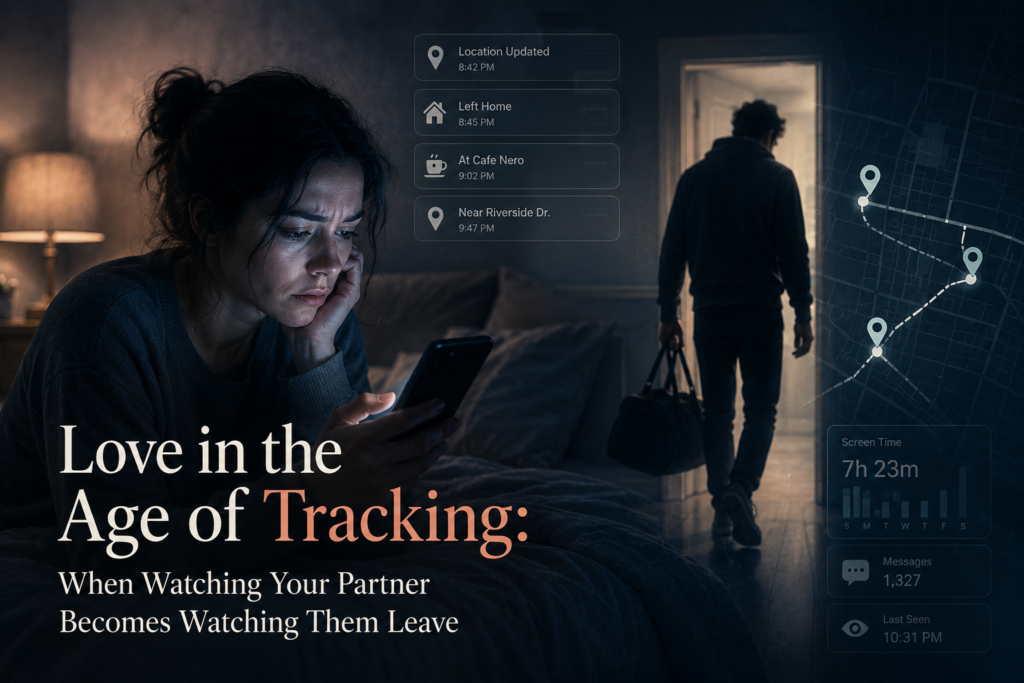
Today, love exists inside a glass house. Your location pings on a shared iPhone map. Your “last seen” timestamp betrays you before you even open a message. Dating apps analyse your swipe patterns, your camera roll, your behavioural data — and sell that information to advertisers while promising you a soulmate. Your partner can see when you’ve read their message, when you were last online, and whether you’ve been “active recently” on an app you swore you deleted. privacy in relationships
We have never known more about the people we love — or the people we’re trying to love. And yet, by many measures, we have never felt more anxious, more mistrustful, or more disconnected in our romantic relationships.
So the question worth asking honestly is this: has surveillance become the enemy of intimacy? Is privacy not just a legal concept or a tech policy issue, but the very oxygen that romance needs to survive? privacy in relationships
The All-Seeing Relationship
Let’s be honest about what modern relationships actually look like in 2025. Couples routinely share live location access with each other — not because they’re controlling, but because it feels practical, even caring. Parents started it with their children, and somewhere along the way, romantic partners adopted the same logic. “It’s just so I know you got home safe.” “It’s easier than texting to ask where you are.”
Research on location-sharing apps among romantic couples reveals that horizontal surveillance has become pervasive due to the rapid development of social media and is especially significant in romantic relationships. What’s striking is that this surveillance isn’t always experienced as intrusive — at first. Studies show that acceptance of monitoring negatively associates with perceived intrusion, meaning the more a partner accepts being monitored, the less they report feeling intruded upon. In other words, we adapt. We normalise. We stop noticing the cage because we helped build it together. privacy in relationships
But normalisation is not the same as health.
Beyond location sharing, the surveillance architecture of modern romance is vast. Social media platforms show you who liked your partner’s photo and when. Read receipts on WhatsApp create micro-anxieties around response times. Instagram’s “Active Now” status has ended more than a few relationships — not because anyone did anything wrong, but because the data created suspicion where none was warranted. We are drowning in information about each other and starving for genuine understanding. privacy in relationships
What Dating Apps Are Actually Doing With Your Love Life
Before a relationship even begins, surveillance is already at work. Dating apps — the primary way millions of people now meet potential partners — have become, in the words of researchers and privacy advocates, some of the most invasive data collectors in existence.
Mozilla Foundation’s review of 25 popular dating apps found that 22 earned its “Privacy Not Included” warning label — a significant deterioration from its 2021 assessment. The research revealed that 80 per cent of dating apps may share or sell user information for advertising purposes, while 52 per cent had experienced a data breach, leak, or hack in the past three years. Dating apps, Mozilla concluded, had become worse for privacy than nearly any other technology category. LiveTre
Think about what that means in human terms. When you create a dating profile, you hand over your age, your photos, your location, your sexual preferences, your relationship goals, and increasingly your behavioural patterns — how long you look at a profile, what kind of faces you swipe right on, what time of day you’re most active. The romanticised meet-cutes of the past have largely been supplanted by complex algorithms that know your romantic preferences better than your closest friends — and monetise that knowledge without your meaningful consent. Accio
When Tinder launched its AI assistant “Chemistry” in late 2025, the feature was positioned as a tool for better matchmaking through deeper personalisation. What it actually required was access to users’ camera rolls — perhaps the most intimate repository of personal data on any device — in exchange for algorithmic matchmaking. The trade-off was seductive and deeply troubling in equal measure. privacy in relationships
Facial recognition technology has further turned dating apps into a new surveillance front — a system built from the digital footprints of millions of ordinary people that turns curiosity into surveillance and romance into risk. privacy in relationships
We are not just looking for love on these platforms. We are being watched while we look. privacy in relationships
The Partner Surveillance Problem
Once a relationship begins, a different kind of watching takes over. Checking a partner’s social media isn’t new — jealousy is as old as love itself. But digital tools have given jealousy extraordinary new capabilities.
Research defines digital monitoring in relationships as checking on a partner’s whereabouts or latest online actions — a practice often described as unhealthy and negative, though in some instances it may provide reassurance. The problem is that the line between reassurance and control is thinner than most people admit to themselves. privacy in relationships
Studies show that younger women have significantly increased odds of engaging in digital monitoring compared to older women, and that past experiences with digital abuse and offline psychological abuse are significant predictors of monitoring behaviour. This tells us something important: surveillance in relationships is often rooted in pain, not malice. People who have been lied to, gaslit, or betrayed reach for monitoring tools not because they want to control their partner, but because they are trying to protect themselves from being hurt again. privacy in relationships
That context matters enormously. But it doesn’t change the outcome. A relationship built on monitoring — even mutual, consensual, well-intentioned monitoring — is a relationship built on a foundation of managed distrust rather than freely chosen faith.
Privacy Is Not Secrecy
Here is where the conversation usually goes wrong. When people argue for privacy in relationships, they are immediately accused of wanting to hide something. “If you have nothing to hide, you have nothing to fear” — a phrase that sounds reasonable and is actually corrosive to every form of intimacy it touches.
Privacy in a relationship is not about deception. It is about personhood. It is the quiet acknowledgement that the person you love existed before you arrived and will continue to be a full human being throughout your relationship — with inner thoughts you won’t always know, friendships that don’t include you, and a private self that doesn’t owe itself to the relationship.
Partners can be empowered to trust one another by respecting their autonomy instead of insisting on surveillance. Well-practised privacy habits can strengthen independence while preserving emotional intimacy — establishing a balance in relationship patterns. Pro News Zone
The most secure people in relationships are not the ones who have the most access to their partner’s phone. They are the ones who have enough trust in themselves and their relationship that they don’t need it. That security isn’t built through surveillance. It is built through honesty, consistency, and the repeated experience of being chosen — not monitored, not tracked, but genuinely, freely chosen.
Mystery, too, plays a role that modern relationships dangerously underestimate. Desire requires distance. The French psychotherapist Esther Perel has written extensively about how the erotic imagination needs uncertainty and space to thrive. When you know exactly where your partner is every moment, exactly who they’re with, exactly when they read your last message — something in the chemistry of wanting begins to flatten. Surveillance doesn’t just threaten trust. It threatens desire itself.
When Surveillance Becomes Control
It is also critical to name what surveillance looks like when it crosses into abuse. Because the same technologies that couples adopt casually and consensually are also wielded as weapons in coercive relationships.
Location sharing that begins as mutual convenience can become a tool of control when one partner uses it to monitor, restrict, and intimidate. Access to a partner’s messages — whether obtained by force, manipulation, or pressure disguised as trust — is a form of violation regardless of how it is framed. Digital surveillance in abusive relationships is not a feature of love gone wrong. It is a feature of control dressed as love.
A privacy breach in a dating app isn’t just about identity theft or spam — it’s about emotional safety. For many, these apps are places of vulnerability: closeted individuals, victims of abuse looking for new beginnings, people exploring identities they can’t share elsewhere. The stakes of surveillance in romantic contexts are not abstract. They are deeply, personally human. Smart Infovision
Rebuilding Intimacy in the Age of Oversharing
So what does healthy romance look like in a world that has made surveillance the default?
It starts with an honest conversation about digital boundaries — one that most couples never have. Freedom of discussion regarding the expectations of privacy can be used to avoid future conflicts. Not “can I see your phone?” but “what does privacy mean to each of us, and how do we honour that while still building closeness?” Pro News Zone
It means resisting the urge to reach for monitoring as a first response to anxiety. When you feel the impulse to check your partner’s location, their last seen status, or their social media activity — that impulse is worth examining. It is rarely about the information itself. It is about an underlying fear that deserves a conversation, not a screen.
It means accepting that uncertainty is not the enemy of love — it is part of love. Not knowing everything about your partner is not a problem to be solved with technology. It is a feature of respecting another person’s full humanity.
And it means demanding better from the platforms that profit from our search for connection. Trust has become one of the most valuable currencies online. Users are more informed, more skeptical, and quicker to abandon apps that feel shady. We should use that power. We should choose platforms that treat our most vulnerable emotional data with genuine care, not as a revenue stream. Smart Infovision
The Verdict
Privacy is not killing romance. The erosion of privacy is.
Romance has always needed room — room to wonder, room to trust, room to choose each other without being watched while doing it. The surveillance architecture of modern love — from data-hungry dating apps to location-sharing between partners to the constant ambient awareness of social media — is slowly collapsing that room.
We can get it back. But only if we’re willing to do something that feels increasingly countercultural in 2025: choose to know a little less, and trust a little more.
Love has never been about certainty. It has always been a leap — and the leap only means something if you’re not wearing a tracking device when you jump.
Here are 10 compelling FAQs perfectly matched to the article “Love Under Surveillance: Is Privacy Killing Romance?”:
❓ FAQ Section — Love Under Surveillance: Privacy, Romance & Digital Trust
Q1. Is it normal for couples to monitor each other digitally in 2025? Yes — and that’s exactly what makes it worth examining. Location sharing, read receipts, social media monitoring, and shared app access have become so normalized in modern relationships that most couples don’t question them. Research shows that acceptance of monitoring grows over time, meaning partners gradually stop perceiving it as intrusive even when it is. Normal doesn’t always mean healthy — and in 2025, the line between caring and controlling has never been blurrier.
Q2. Does sharing your location with your partner destroy trust or build it? It depends entirely on the motivation behind it. Location sharing born from genuine mutual convenience — “ping me when you leave so I can start dinner” — is very different from location sharing born from anxiety, jealousy, or the need to verify a partner’s honesty. The former can be a practical tool. The latter is a sign that the relationship needs a conversation, not a tracking app. Real trust is built through honesty and consistency — not through GPS coordinates.
Q3. How do dating apps violate your privacy before a relationship even begins? Significantly. Research by Mozilla Foundation found that 80 per cent of popular dating apps may share or sell user data for advertising purposes, and 52 per cent had suffered a data breach in recent years. Apps collect your photos, location, swipe behaviour, preferences, and activity patterns — then use that data for advertising, algorithmic profiling, and in some cases sell it to third parties. You are not just looking for love on these platforms. You are being studied, categorised, and monetised while you look.
Q4. What is the difference between privacy and secrecy in a relationship? This is one of the most important distinctions in any healthy relationship. Privacy is about personhood — the right to have inner thoughts, personal friendships, and a private self that exists independently of your relationship. Secrecy is about concealment — deliberately hiding information that would matter to your partner. A person who wants privacy isn’t hiding an affair. They’re asserting that they are a complete human being outside of their relationship. Healthy love respects that distinction. Controlling love deliberately blurs it.
Q5. Can too much information about your partner kill attraction and desire? Yes — and this is the part of the surveillance conversation that almost nobody talks about. Desire requires a degree of distance and mystery. When you know exactly where your partner is every hour, exactly who they’re with, and exactly when they read your last message, the erotic imagination has nothing left to work with. Psychotherapist Esther Perel has written extensively about how intimacy and desire exist in tension — and how the collapse of personal space between partners often leads to the collapse of passion as well.
Q6. When does partner monitoring cross the line into abuse? When it is used to control, intimidate, restrict, or punish. Monitoring that begins as mutual and consensual can become coercive when one partner uses location data to question movements, demands access to messages as proof of loyalty, or uses digital information to isolate their partner from friends and family. Technology doesn’t create abusive relationships — but it gives abusers extraordinarily powerful new tools. If monitoring in your relationship feels mandatory rather than chosen, that is a serious warning sign worth taking seriously.
Q7. Why do people monitor their partners digitally even when they know it’s unhealthy? Usually because of fear — specifically the fear of being hurt, betrayed, or blindsided again. Research shows that past experiences of digital abuse, psychological manipulation, and gaslighting significantly increase the likelihood of monitoring behaviour in future relationships. People who have been lied to reach for monitoring tools not because they want to control their partner, but because they are trying to protect themselves. Understanding that motivation is important — but it doesn’t make the behaviour less damaging to the relationship long-term.
Q8. How should couples set healthy digital boundaries in a relationship? Start with an honest conversation — one most couples never actually have. Discuss what privacy means to each of you individually, what access feels comfortable and what feels invasive, and what the motivation is behind any monitoring tools you use together. Healthy digital boundaries look like mutual agreement rather than unilateral access, chosen sharing rather than demanded transparency, and trust that is built through communication rather than verification. Revisit these boundaries as the relationship evolves — they are not a one-time discussion.
Q9. Are dating apps safe to use from a privacy standpoint in 2025? Largely, no — at least not without significant caution. The Mozilla Foundation’s 2024 review awarded 22 out of 25 popular dating apps its “Privacy Not Included” warning label, making the category worse for privacy than almost any other type of consumer technology. Features like AI-powered matchmaking that access your camera roll, behavioural tracking, and vague data-sharing policies mean users routinely hand over deeply personal information with little understanding of where it goes. Using strong privacy settings, limiting location permissions, and reading data policies before signing up are basic but important protective steps.
Q10. Can a relationship survive and thrive with genuine privacy and independence? Not only can it — it almost certainly needs it to. The most secure, lasting relationships are built on freely chosen commitment rather than monitored compliance. When both partners maintain a sense of individual identity, personal space, and mutual respect’s privacy, the relationship has room to breathe, grow, and sustain genuine desire over time. Choosing to know a little less and trust a little more is not naivety. In the age of surveillance, it is one of the most radical and loving things two people can do for each other.