

Claude AI military use highlights how artificial intelligence is being explored for intelligence analysis and defense technology. Artificial intelligence is rapidly transforming modern warfare, and recent developments in the Middle East highlight just how central AI has become to military strategy. Reports indicate that Claude, an advanced artificial intelligence system developed by the U.S. company Anthropic, was used by American military forces during operations targeting Iran. The incident has sparked intense debate worldwide about the role of AI in combat, the ethics of automated decision-making, and the growing influence of technology companies in national security matters.
This emerging intersection of AI and warfare represents a major shift in how military operations are planned, analyzed, and executed. Claude ai millitary use is beneficial to the millitary.
The Role of Claude AI in U.S. Military Operations
Claude is a large language model created by Anthropic, a San Francisco–based artificial intelligence company founded in 2021. The system was originally designed to assist with reasoning, analysis, and complex decision-making tasks. Over time, however, it began to be integrated into government and intelligence systems used by U.S. defense agencies. (Wikipedia)
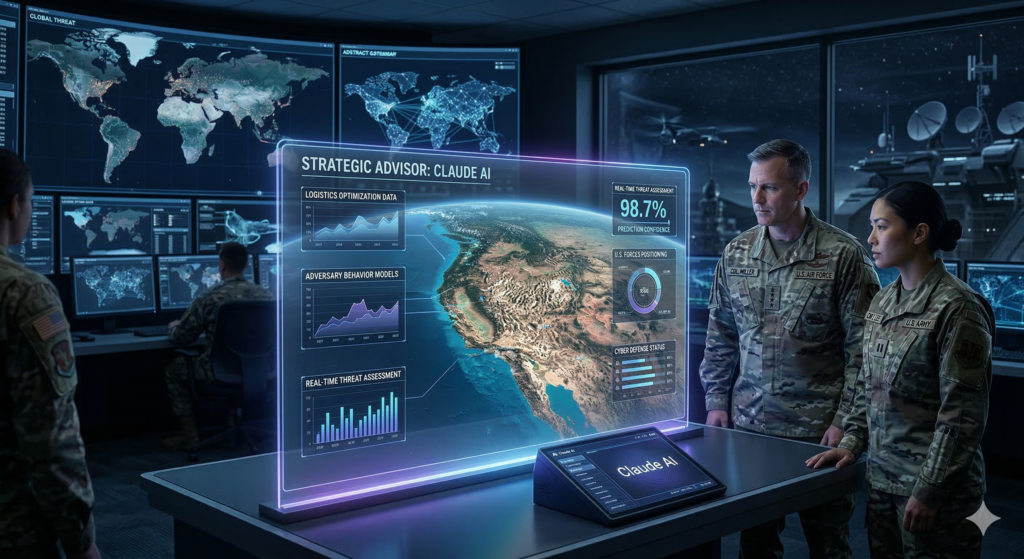
According to reports, the U.S. military relied on Claude during operations targeting Iranian assets in the region. The AI system was used to support several key aspects of battlefield planning, including:
- Intelligence analysis
- Target identification
- Simulation of combat scenarios
- Evaluation of weapons and logistics
U.S. Central Command reportedly employed the system to process large volumes of data and generate insights that would normally take analysts many hours or days to produce. (The Times of India)
By using AI to sift through satellite imagery, intelligence reports, and operational data, commanders could make decisions much faster than traditional methods allowed.
AI Accelerating the “Kill Chain”
One of the most significant impacts of AI in warfare is the compression of the “kill chain.” This term refers to the sequence of steps required to identify a target, analyze it, decide on a course of action, and execute a strike.
With AI systems like Claude, this process can occur dramatically faster. Reports suggest that AI tools helped analyze intelligence and prioritize targets at unprecedented speed during the U.S. operations against Iran. (The Guardian)
In modern conflicts, speed can be decisive. The ability to analyze enormous datasets and recommend actions in real time gives military commanders a major strategic advantage. Claude AI military use
However, critics warn that accelerating the kill chain could also increase the risk of mistakes or unintended consequences if humans rely too heavily on automated recommendations.
Controversy Over the Use of Claude
The use of Claude in combat operations became controversial almost immediately. Just hours before the strikes on Iran, the U.S. government had reportedly ordered federal agencies to stop using Anthropic’s AI systems due to disagreements over how the technology should be deployed. (www.ndtv.com)
Despite this directive, the military continued using Claude because the technology was already deeply integrated into operational systems. Transitioning away from it overnight was simply not possible. Claude AI military use
The situation exposed the complex relationship between governments and private AI companies. On one side, military agencies want powerful AI tools to strengthen national security. On the other side, technology companies often worry about how their creations might be used in warfare.
Ethical Concerns From AI Developers
Anthropic itself has expressed strong concerns about the use of its technology in military applications. The company has repeatedly stated that it does not want its AI systems used for autonomous weapons or mass surveillance. (AP News)
The company’s leadership argues that current AI systems are still too unpredictable to be trusted with life-and-death decisions. Errors in AI-generated recommendations could potentially lead to civilian casualties or escalation of conflicts.
These concerns led to a major dispute between Anthropic and the U.S. government. When the company refused to remove certain safeguards from its AI models, U.S. officials labeled it a national security risk and began phasing out its technology from federal agencies. (The Times of India) Claude AI military use
This dispute illustrates the growing tension between ethical AI development and military demands.
The Growing Role of AI in Warfare
Despite the controversy, the use of AI in military operations is likely to expand rather than decline. Modern warfare increasingly relies on massive amounts of data—from satellites, drones, sensors, and intelligence networks. Claude AI military use
Processing this information quickly is nearly impossible without artificial intelligence.
In addition to AI systems like Claude, the United States has deployed advanced technologies such as:
- Stealth bombers
- Autonomous drones
- Long-range cruise missiles
- AI-assisted intelligence platforms
During recent strikes against Iranian targets, the U.S. military reportedly used a combination of these technologies, including new low-cost attack drones and advanced targeting systems. (Reuters)
Together, these tools represent a new generation of technology-driven warfare.
Risks of AI-Driven Military Decisions
While AI offers clear advantages in speed and efficiency, experts warn that it also introduces serious risks.
One major concern is over-reliance on automated recommendations. If commanders begin to trust AI outputs without sufficient human review, mistakes could happen faster and at a larger scale.
Another concern is what researchers call “decision compression.” When decisions must be made extremely quickly, there is less time for human oversight or ethical consideration.
Critics argue that this could lead to a future where AI systems effectively shape battlefield decisions, even if humans technically remain in control. Claude AI military use
A Turning Point in Military Technology
The use of Claude during U.S. operations against Iran may represent a turning point in military history. For the first time, a conversational AI system similar to those used by the public has reportedly played a direct role in analyzing targets and assisting combat planning.
This development signals the beginning of an era where AI becomes a core component of military operations, not just a supporting technology.
Just as radar and computers revolutionized warfare in the 20th century, artificial intelligence could define the strategic landscape of the 21st century. Claude AI military use
The Future of AI in Defense
As governments around the world race to integrate artificial intelligence into their defense systems, the debate about ethics and regulation will likely intensify.
Key questions remain unresolved:
- How much decision-making should AI systems control?
- Who is responsible if AI recommendations lead to civilian casualties?
- Should private companies restrict how governments use their AI technologies?
These issues will shape the future of both warfare and artificial intelligence.
For now, the events surrounding Claude’s use in U.S. operations against Iran highlight a clear reality: AI is no longer just a technological innovation—it is becoming a strategic weapon. Claude AI military use