
Google Stitch AI design tool Google introduces Stitch, an AI design tool that turns natural language into UI designs. Learn how vibe design is transforming software creation and UI development. Artificial intelligence is rapidly transforming the way software is created, designed, and developed. Over the past few years, AI has evolved from being just a supporting tool into becoming an active collaborator in the creative process. Google’s latest innovation, Stitch, represents another major step forward in this transformation. With the introduction of what Google calls “vibe design,” Stitch is becoming an AI-native design platform that allows users to create high-quality user interface designs simply by describing their ideas in natural language.
This development signals a shift in how digital products may be designed in the future. Instead of relying only on technical design knowledge or complex software tools, creators can now express their ideas in plain language and allow AI to help turn those ideas into working visual designs.
What is Stitch and Why It Matters
Stitch is Google Labs’ experimental AI design platform focused on simplifying the design process. Its goal is to make software design more accessible, collaborative, and efficient. Traditionally, creating UI designs required professional tools, structured workflows, and often years of design experience. Stitch aims to remove many of these barriers.
By allowing users to describe what they want to build rather than manually constructing every element, Stitch enables both professionals and beginners to participate in the design process. This approach makes software design more inclusive and allows entrepreneurs, developers, and creators to rapidly test ideas.
The concept behind Stitch reflects a larger trend in AI development: reducing friction between ideas and execution. The faster someone can move from concept to prototype, the more innovation becomes possible.
Understanding “Vibe Design”
One of the most interesting ideas introduced with Stitch is the concept of “vibe design.” This approach focuses on capturing the intention and emotional direction of a project rather than starting with technical design structures.
Instead of beginning with wireframes or layouts, users can describe:
- The business goal of the software
- The type of user experience they want to create
- The emotions they want users to feel
- Inspirations from other products
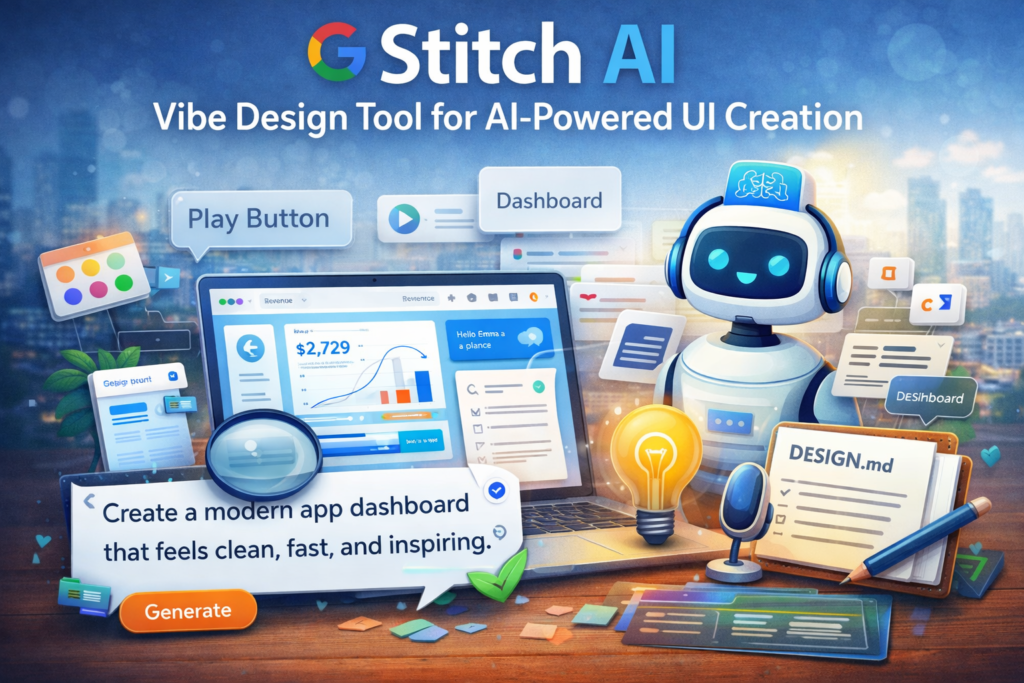
For example, instead of designing a dashboard manually, a user might say:
“Create a modern dashboard for a productivity app that feels clean, fast, and motivating.”
The AI then interprets this direction and generates design suggestions that match the described vibe. This allows designers to explore multiple creative directions quickly without starting from scratch each time. Google Stitch AI design tool
This idea highlights AI’s role as a creativity multiplier. Rather than replacing designers, it helps them explore more possibilities in less time.
A New AI-Native Design Canvas
Google has also redesigned Stitch’s interface into what it describes as an AI-native design canvas. This canvas acts as a flexible workspace where ideas can evolve from early concepts into functional prototypes. Google Stitch AI design tool
Unlike traditional design tools that rely on structured layers and rigid workflows, Stitch provides an infinite canvas where users can combine different types of input, including:
- Text descriptions
- Images
- Code snippets
- Design references
This flexible environment reflects how real creative thinking works. Designers often move between exploration and refinement phases, and the Stitch canvas supports this natural workflow. Google Stitch AI design tool
The platform also allows users to bring different types of inspiration into the same space, helping maintain context throughout the design process.
AI Design Agents and Project Intelligence
Another major feature of Stitch is the introduction of an intelligent design agent. This AI component can understand the evolution of a project and assist users based on previous changes and ideas. Google Stitch AI design tool
The system also includes an Agent Manager, which helps track different ideas and variations being explored simultaneously. This is particularly useful for teams working on multiple design directions at once.
Instead of losing track of different versions or ideas, the system helps organize them and allows users to compare approaches easily. This structured creativity is important for modern design workflows where iteration is constant.
By combining project memory with AI reasoning, Stitch acts as more than a design generator—it becomes a design partner. Google Stitch AI design tool
Design Systems Made Simpler
Design systems are important for maintaining consistency across digital products. However, creating and maintaining design systems often requires extensive documentation and coordination. Google Stitch AI design tool
Stitch introduces new tools that simplify this process. Users can extract design systems directly from websites or URLs, allowing them to analyze and reuse design patterns. Additionally, the introduction of DESIGN.md files allows users to export and import design rules between projects. Google Stitch AI design tool
This means designers no longer need to rebuild design foundations for every new project. Instead, they can reuse and adapt existing systems efficiently.
This approach saves time and ensures consistency across projects while reducing repetitive work.
Faster Iteration and Real-Time Prototyping
Design is rarely perfect on the first attempt. It requires constant testing, feedback, and refinement. Stitch addresses this need by allowing users to instantly convert static designs into interactive prototypes.
Instead of imagining how a user might interact with a design, creators can immediately test navigation flows and user journeys. Users can connect screens, simulate interactions, and preview how an application might function.
The ability to quickly test ideas is critical for maintaining creative momentum. When feedback loops are fast, designers can experiment more freely and refine ideas quickly.
Stitch also helps predict logical next steps in a design flow. For example, if a user clicks a button in a prototype, the AI can suggest the next screen or interaction path.
This capability significantly reduces the time required to move from concept to usable design.
Voice Interaction and AI Collaboration
One of the most innovative features of Stitch is voice interaction. Users can now speak directly to the AI and request design changes in real time.
For example, users might say:
- “Show three different color themes.”
- “Make this layout more minimal.”
- “Create a new landing page.”
The AI responds by making immediate adjustments, allowing for a more natural creative workflow.
This conversational interaction makes design feel less technical and more intuitive. Instead of navigating complex menus, users can communicate their ideas naturally.
AI also provides feedback during the process. It can suggest improvements, highlight design issues, and help refine ideas through dialogue.
This turns the design process into a collaboration between human creativity and machine intelligence.
Connecting Design to Development
Design is only one part of software creation. Eventually, designs must be turned into code. Stitch aims to bridge this gap by supporting integrations with developer tools.
Using Stitch’s MCP server and SDK, developers can connect designs to other platforms and workflows. The platform also supports exporting designs to developer environments, ensuring smooth transitions between design and development phases.
This integration helps maintain alignment between designers and developers, reducing miscommunication and improving efficiency.
Instead of designs being isolated documents, they become active parts of the development process.
Who Can Benefit from Stitch
Stitch is designed to help a wide range of users.
Professional designers can use it to explore multiple variations quickly and test creative directions. Startups and founders can use it to prototype ideas without hiring full design teams. Developers can use it to visualize product concepts more clearly.
Even non-technical users can benefit. Entrepreneurs with ideas but no design background can now experiment with product concepts using natural language.
This democratization of design tools could significantly increase innovation by lowering entry barriers.
The Future of AI-Assisted Design
The introduction of platforms like Stitch suggests that the future of software design will involve closer collaboration between humans and AI. Instead of replacing designers, AI will likely become a co-creator that enhances productivity.
Future developments may include:
- More personalized design suggestions
- Smarter user behavior predictions
- Real-time accessibility recommendations
- Automated usability testing
As AI continues to improve, design tools will likely become more intuitive and adaptive.
Conclusion
Google’s Stitch platform and the introduction of “vibe design” represent an important step toward a more accessible and efficient design future. By allowing users to describe ideas instead of manually constructing designs, Stitch reduces complexity and speeds up innovation.
Its AI-native canvas, intelligent design agents, voice interaction features, and development integrations demonstrate how AI can transform creative workflows. By making design more collaborative and intuitive, Stitch shows how technology can empower creators rather than replace them.
As the gap between ideas and execution continues to shrink, tools like Stitch may redefine how software is imagined and built. Whether used by professionals or beginners, AI-assisted design platforms are likely to become essential components of the modern digital creation process.
The era of “vibe design” may just be the beginning of a future where creativity and technology work together more seamlessly than ever before.