

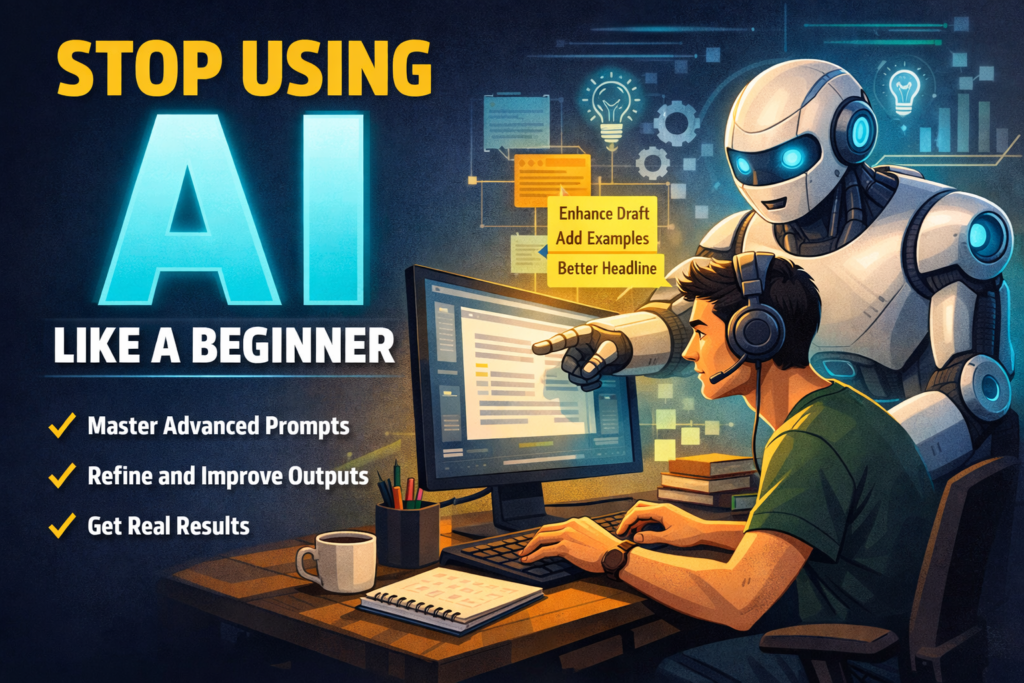
stop using ai like a beginner. Artificial intelligence tools like ChatGPT, Claude, and others are everywhere now. People are using them for writing, coding, business ideas, and even making money online. But here’s the truth—most users are still using AI like beginners.
They ask simple questions, accept average answers, and then wonder why they’re not getting powerful results.
If that sounds familiar, don’t worry. This guide will show you exactly how to stop using AI like a beginner and start using it like a pro. Stop using ai like a beginner
1. Beginners Ask, Experts Direct
The biggest difference between a beginner and an advanced AI user is how they give instructions.
A beginner might type:
“Write an article about AI.”
An advanced user writes:
“Write a 1200-word article in a conversational tone for Indian readers explaining how AI is changing jobs, include real-life examples, avoid generic phrases, and make it engaging like a news feature.” stop using ai like a beginner
See the difference?
AI is not just a search engine. It’s more like an assistant. The more clearly you guide it, the better it performs. stop using ai like a beginner
Upgrade your approach:
- Be specific
- Define tone (casual, professional, storytelling)
- Mention audience
- Set length and structure
2. Stop Accepting the First Answer
Beginners take the first output and use it immediately.
That’s a mistake.
AI’s first answer is often just a draft. The real magic happens when you refine it.
Instead of stopping, try:
- “Make it more engaging”
- “Rewrite in simpler English”
- “Add examples”
- “Make it sound less robotic”
Think of AI like a junior employee. You wouldn’t accept their first draft without feedback, right? Stop using AI like a beginner
3. Use Layered Prompting (This Changes Everything)
Advanced users don’t ask everything in one prompt. They build step-by-step.
Example workflow:
Step 1:
“Give me 10 ideas for viral YouTube videos about AI.”
Step 2:
“Expand idea number 3 into a full script.”
Step 3:
“Make it suitable for a 1-minute silent video with text overlays.”
Step 4:
“Add emotional hooks and a strong ending.”
This is called layered prompting, and it dramatically improves quality. stop using ai like a beginner
4. Give Context Like a Human Would
AI works best when it understands the situation.
Beginners:
“Write a product description.”
Better:
“Write a product description for a low-budget fitness watch targeting Indian college students, highlight affordability and battery life, keep tone energetic.” stop using ai like a beginner
Context = better results.
Always ask yourself:
- Who is this for?
- What is the goal?
- What style do I want?
5. Treat AI Like a Specialist, Not a General Tool
Most users treat AI like a “do everything” machine.
Instead, assign it a role.
For example:
- “Act as a YouTube growth expert”
- “Act as an Amazon KDP strategist”
- “Act as a digital marketing consultant”
This immediately improves the depth of responses.
You’re not just asking—you’re positioning AI into a mindset. stop using ai like a beginner
6. Use AI for Thinking, Not Just Writing
Beginners only use AI to generate content.
Advanced users use it to:
- Brainstorm ideas
- Analyze trends
- Improve strategies
- Solve problems
For example:
Instead of:
“Write a blog”
Try:
“Why is my blog not getting traffic? Analyze possible reasons and suggest improvements.”
This shift turns AI into a strategy partner, not just a content generator. stop using ai like a beginner
7. Learn to Edit AI Output
Here’s something most people ignore:
Even the best AI output needs editing.
Why?
- It may sound slightly robotic
- It may repeat ideas
- It may lack personality
What you should do:
- Add your own voice
- Remove unnecessary lines
- Simplify complex sentences
- Add real-life examples
Think of AI as your first draft machine, not the final product. stop using ai like a beginner
8. Avoid Generic Prompts
Generic prompts = generic results.
Example of bad prompt:
“Give me business ideas”
Better:
“Give me 10 low-investment online business ideas suitable for Indian beginners with less than ₹5000 budget, focus on fast monetization.” stop using ai like a beginner
Specificity creates uniqueness.
9. Combine Multiple AI Tools (Advanced Move)
Beginners use only one tool.
Smart users combine tools.
Example workflow:
- ChatGPT → script
- Lumen5 → video
- Canva → thumbnails
- Clipchamp → editing
This multiplies productivity.
AI is not one tool—it’s an ecosystem.
10. Use AI to Make Money, Not Just Content
Many people generate content but never monetize it. stop using ai like a beginner
That’s beginner thinking.
Instead, ask:
- “How can I turn this into income?”
- “Where can I publish this?”
- “What platform monetizes fastest?”
Examples:
- Turn articles into KDP books
- Turn scripts into YouTube videos
- Turn ideas into digital products
AI should lead to action, not just creation.
11. Train AI with Your Preferences
You can guide AI to match your style over time.
Say things like:
- “Write like a human, not robotic”
- “Use simple English”
- “Avoid repetition”
- “Use storytelling”
The more you guide, the better it adapts. stop using ai like a beginner
12. Stop Over-Relying on Copy-Paste
Copy-pasting AI output directly is one of the biggest beginner mistakes.
Problems:
- Looks generic
- Can be flagged as AI-generated
- Lacks originality
Instead:
- Rewrite parts
- Mix your own thoughts
- Add examples from your life
This creates authentic content, which performs better.
13. Ask AI to Critique Your Work
This is a powerful but underused trick.
Try:
“Review this article and tell me what’s weak.”
Or:
“Act as a harsh editor and give feedback.”
AI becomes your personal reviewer.
14. Use Constraints for Better Output
Constraints actually improve creativity.
Examples:
- “Write in 100 words”
- “Use only simple vocabulary”
- “Make it suitable for 8th-grade readers”
Without limits, AI tends to be vague.
15. Practice Prompt Engineering Daily
Like any skill, using AI effectively improves with practice.
Try experimenting:
- Change wording
- Add constraints
- Test different tones
You’ll quickly see what works best.
Final Thoughts
The difference between a beginner and an advanced AI user is not intelligence—it’s approach.
Beginners:
- Ask simple questions
- Accept average answers
- Use AI casually
Advanced users:
- Give clear instructions
- Refine outputs
- Use AI strategically
If you start applying even a few of the techniques above, your results will improve immediately.
AI is one of the most powerful tools available today—but only if you know how to use it properly.
So the next time you open an AI tool, don’t just ask.
Guide it. Shape it. Challenge it.
That’s how you stop using AI like a beginner—and start using it like a pro.