

Apple Siri AI update delay. At 1:19 PM PST on February 11, 2026, Apple CEO Tim Cook addressed audiences during a keynote at a special Apple event in Cupertino, California. However, behind the scenes, one of Apple’s most anticipated upgrades appears to be hitting more roadblocks.
Apple first introduced its ambitious AI-powered Siri transformation when it unveiled Apple Intelligence in 2024. Since then, the company has repeatedly adjusted the release timeline. Now, according to a fresh report from Bloomberg’s Mark Gurman, users may have to wait even longer for the revamped assistant.
Originally, Apple planned to roll out the upgraded Siri with the iOS 26.4 update in March. Instead, the company now intends to release the new features gradually. Some updates may arrive in May with a later iOS release, while others could be pushed back as far as iOS 27 in September. During internal testing, Apple reportedly encountered software issues that forced engineers to delay the launch once again.
Meanwhile, expectations remain high. Apple aims to transform Siri into a more advanced, conversational assistant similar to today’s large language model chatbots. Rather than opening a separate app like ChatGPT or Claude, users would simply speak to Siri directly on their iPhone or Mac. Reports suggest the assistant will run on Google’s Gemini AI technology, bringing more natural, context-aware interactions to Apple devices.
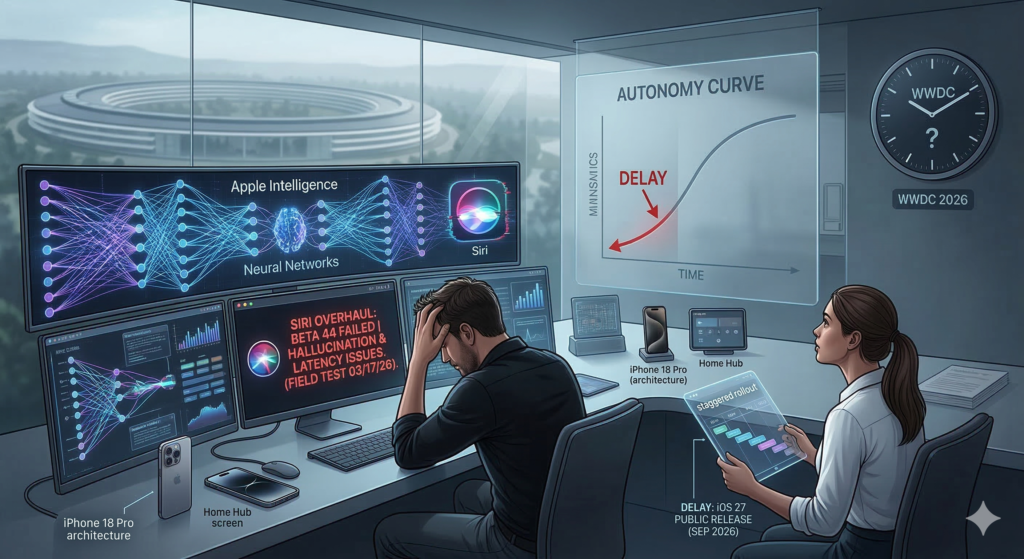
For now, though, Apple appears focused on refining the experience before releasing it publicly. While delays can frustrate eager users, they often signal that a company wants to get the details right.
And as for the Siri product team — they’re undoubtedly working overtime to bring this next chapter to life.
Why Apple’s AI Strategy Looks Different From Its Competitors Apple Siri AI update delay
Apple’s cautious approach to artificial intelligence is not accidental. Unlike many technology companies that prioritize rapid deployment, Apple has historically focused on controlled releases that emphasize stability, privacy, and long-term ecosystem integration. This philosophy may explain why the company appears willing to delay major features rather than release unfinished AI capabilities.
In recent years, competitors like Google, Microsoft, and OpenAI have accelerated AI development at an unprecedented pace. New features are being introduced almost monthly, often with the understanding that improvements will continue after launch. Apple, however, tends to operate differently. The company prefers to refine products internally and release them only when they meet strict performance standards.
This difference reflects Apple’s broader brand strategy. The company markets its devices not just as powerful tools but as reliable and secure platforms. Any AI feature that behaves unpredictably could damage that reputation. As a result, delays may actually signal Apple’s intention to protect its long-term user trust rather than simply compete on speed. Apple Siri AI update delay
The Challenges of Building a Truly Smart Voice Assistant
Transforming Siri into a modern AI assistant is not a simple upgrade. Traditional voice assistants were designed around command-based interactions. Users asked simple questions or gave direct instructions, and the assistant responded with predefined actions.
Modern AI assistants, however, are expected to understand context, remember previous interactions, and respond conversationally. This requires integrating large language models, improving natural language understanding, and ensuring responses remain accurate and safe.
These improvements also introduce technical challenges. AI models must balance speed with accuracy, especially on mobile devices where processing power and battery consumption are critical concerns. Apple is reportedly working on combining on-device AI processing with cloud-based intelligence, a hybrid approach that could help maintain performance while protecting sensitive user data. Apple Siri AI update delay
What Users Can Expect From the Next Generation of Siri
If Apple successfully delivers its planned improvements, users could see major changes in how Siri functions. Instead of responding only to simple commands, the assistant may be able to manage complex, multi-step tasks. For example, users might ask Siri to summarize messages, organize schedules, suggest replies, or automate workflows across different apps. Apple Siri AI update delay
Another expected improvement is deeper personalization. Future versions of Siri may better understand user preferences, habits, and routines while still maintaining Apple’s privacy standards. This could allow the assistant to make smarter recommendations without requiring users to manually configure settings. Apple Siri AI update delay
Integration across Apple’s ecosystem is also expected to improve. Siri could potentially coordinate actions between iPhones, iPads, Macs, and other Apple devices more intelligently, creating a more seamless digital experience. Apple Siri AI update delay
A Competitive but Careful Future
Despite the delays, Apple remains one of the most influential players in the AI assistant space. The company’s massive installed user base gives it a unique advantage. When new AI features finally arrive, they could reach millions of users almost immediately.
At the same time, Apple’s careful pace highlights an important reality about AI development. Building powerful AI is not just about capability—it is about reliability, safety, and user trust. Companies that move too quickly risk releasing tools that behave unpredictably, while those that move too slowly risk falling behind. Apple Siri AI update delay
Apple appears to be trying to balance both risks. Whether this strategy proves successful will depend on how well Siri’s next evolution meets growing user expectations in an increasingly AI-driven world. Apple Siri AI update delay