
Every blogger knows the feeling — you open a blank page, the cursor blinks, and the words just don’t come. You have ideas, but turning them into polished, readable posts takes hours. The good news? Free AI writing tools for bloggers now make this process faster, smarter, and a whole lot less painful.
In this post, you will discover the best free AI tools that help you draft content, overcome writer’s block, improve SEO, and publish consistently — without paying a single penny. Let’s get into it.
Why bloggers need AI writing tools in 2025
Content demands keep rising. Readers expect fresh, well-researched posts every week. Brands want long-form SEO content. Solopreneurs juggle writing, editing, promoting, and monetising — all at once.
AI writing tools step in to handle the heavy lifting. They generate first drafts, suggest headlines, rephrase weak sentences, and even optimise your content for search engines. You stay in the driver’s seat — but the engine does the grunt work.
And the best part? Many powerful tools cost absolutely nothing to start.
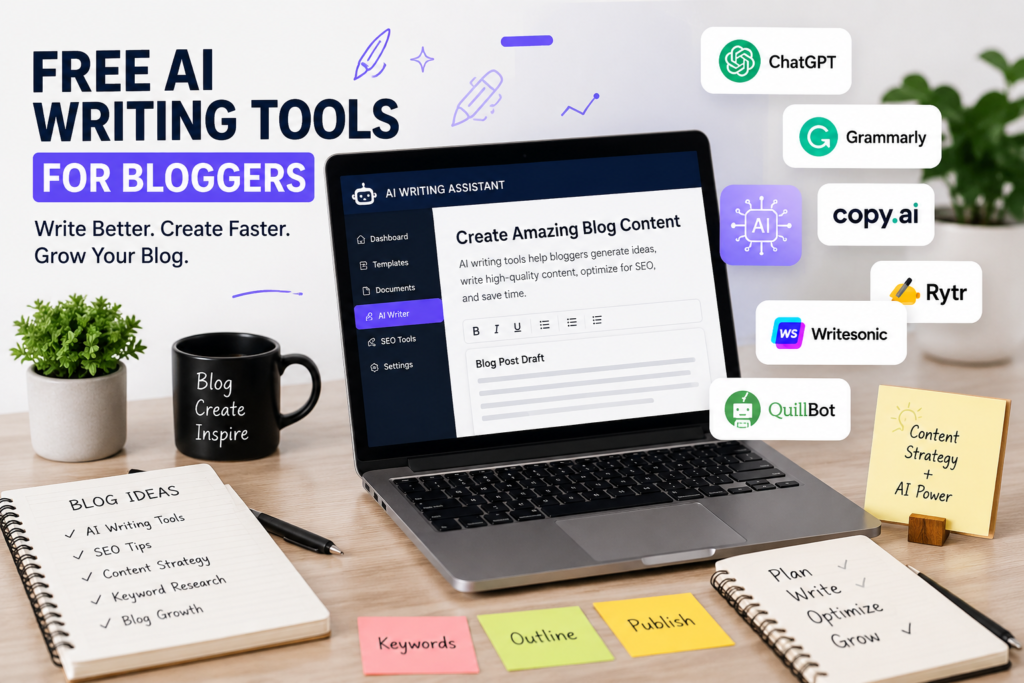
The best free AI writing tools for bloggers
1. ChatGPT (Free Plan — OpenAI)
ChatGPT sits at the top of nearly every blogger’s toolkit. The free plan gives you access to GPT-4o mini, which handles blog outlines, intro paragraphs, section drafts, and even FAQs in seconds.
You type a prompt like “Write a 200-word intro about intermittent fasting for beginners” and ChatGPT delivers a ready-to-edit draft. Use it to brainstorm, rewrite, simplify, or expand any section of your post.
Best for: Drafting, brainstorming, rewriting, Q&A sections.
2. Google Gemini (Free)
Google Gemini integrates directly with Google Docs, Gmail, and Search, making it a natural pick if you already live in the Google ecosystem. You can ask Gemini to draft a full blog post, suggest a better title, or summarise research from the web.
Bloggers who write about current events love Gemini because it pulls up-to-date information and weaves it into your content — something older AI tools struggled with.
Best for: Research-heavy posts, Google Docs users, news-based blogging.
3. Claude (Free Plan — Anthropic)
Claude produces remarkably natural, human-sounding writing. Bloggers who struggle with robotic AI output find Claude refreshing — it follows your tone, respects nuance, and writes with a voice that doesn’t sound like a machine generated it.
Feed Claude your rough notes or bullet points and ask it to turn them into a polished section. It handles long-form content well and keeps the narrative flowing logically from paragraph to paragraph.
Best for: Conversational blog posts, personal brand writing, long-form content.
4. Rytr (Free Plan)
Rytr builds its workflow specifically around content creators. You pick a use case — blog idea, section writing, SEO meta description — choose a tone, and Rytr generates multiple variations. The free plan gives you 10,000 characters per month, which covers several decent blog posts.
The built-in plagiarism checker adds peace of mind, especially for bloggers who monetise through ads and need original content.
Best for: Structured blog sections, SEO snippets, tone-specific writing.
5. Notion AI (Limited Free Credits)
If you plan and draft your content inside Notion, its built-in AI becomes a seamless extension of your workflow. Highlight any text and ask Notion AI to make it shorter, improve the tone, fix grammar, or continue writing where you left off.
New users receive a generous set of free AI credits to try the feature before committing to a paid plan.
Best for: Bloggers who use Notion as a content calendar and draft editor.
6. Canva Magic Write (Free)
Canva is famous for design, but Magic Write quietly turned it into a writing tool too. Inside Canva Docs, you can generate blog intros, listicles, and short sections with a single prompt. This is especially useful for bloggers who also create social media graphics and want everything in one place.
Best for: Bloggers who combine written content with visual branding.
How to use AI writing tools without losing your voice
Many bloggers worry that AI content sounds generic. The solution is simple — treat AI as a collaborator, not a ghostwriter. Follow these principles:
- Give specific prompts. Instead of “write about coffee,” say “write an intro about why cold brew is better than iced coffee for people who hate bitterness.”
- Edit aggressively. Read every line out loud. Replace anything that sounds stiff or unnatural with your own words.
- Add personal stories. AI can’t replicate your experiences. Weave in anecdotes, opinions, and examples only you know.
- Use AI for the hard parts. Struggling with your intro or conclusion? Let AI draft it. Then rewrite it in your voice.
Free AI tools for SEO-focused bloggers
Writing great content is only half the battle — Google needs to find it. These free AI tools help you write with SEO in mind:
- ChatGPT: Ask it to generate LSI keywords, meta descriptions, or FAQs around your focus keyphrase.
- Google Search Generative Experience: Study how AI summaries appear for your target keywords and structure your content to match.
- Semrush Writing Assistant (free tier): Grades your content for SEO, readability, and originality in real time.
- AlsoAsked / AnswerThePublic (free searches): Discover exactly what questions your audience types into Google — then answer them in your posts.
Common mistakes bloggers make with AI tools
AI tools save time, but they introduce new traps. Watch out for these:
- Publishing without editing. Raw AI output often contains inaccuracies and filler phrases. Always fact-check and rewrite.
- Ignoring your niche’s tone. A finance blog sounds different from a travel blog. Adjust AI output to match your genre.
- Over-relying on one tool. Different tools shine at different tasks. Use ChatGPT for drafts, Rytr for variations, Claude for polish.
- Skipping originality checks. Run your AI-generated content through a plagiarism checker before hitting publish.
Final thoughts
The blogging world has changed. Bloggers who embrace free AI writing tools publish faster, reach more readers, and spend less time staring at blank pages. You don’t need a budget — you need the right workflow.
Start with ChatGPT or Claude for your next post. Let AI handle the first draft. Then bring in your experience, personality, and insight to make it genuinely yours.
Your audience reads your blog because of you. AI just helps you show up for them more often.
Additional information: https://dribbble.com/shots/27368496-Genesis?